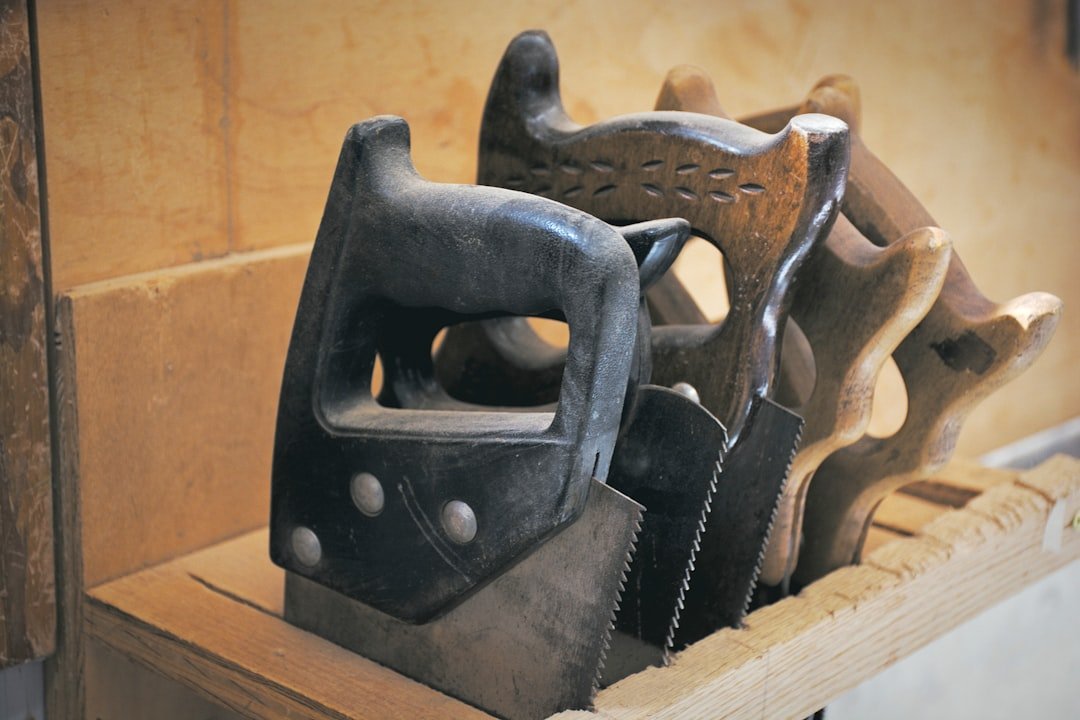
Photo by Samuel Ramos on Unsplash
The Plan Library Problem Nobody Talks About
The first woodworking plan David Ohnstad ever bought was a Mission-style coffee table from a magazine in 2014. Forty-seven pages. Full cut list, assembly diagrams, finishing schedule. He printed the whole thing, put it in a three-ring binder, and set it on the bench. Then he stared at it for three weeks without cutting a single board. The plan didn’t tell him which piece of cherry to buy at the lumberyard, how to read the grain direction on the faces he’d glue up, or what to do when his table saw blade left burn marks the sanding schedule didn’t account for. The plan was complete. It was also useless.
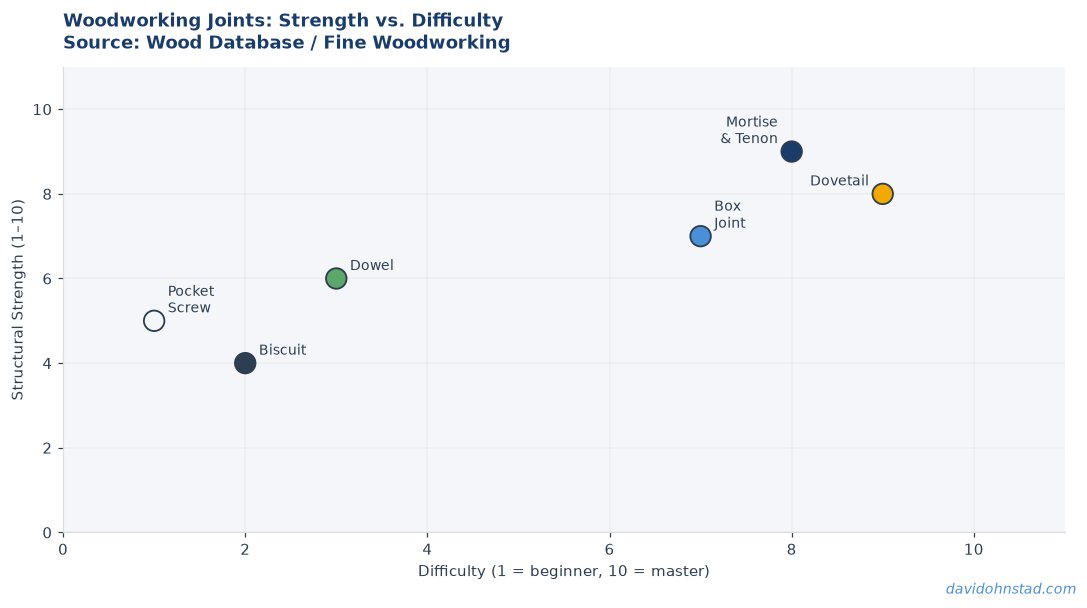
Right now, beginners are being told they need comprehensive plan libraries before they can build anything. SlashGear just published lists of the best free plan websites and YouTube channels for beginners. Newswire covered Ted’s Woodworking—a package claiming 16,000 projects. The message is clear: collect plans first, build later. This is backwards. Plan dependency doesn’t teach woodworking. It teaches plan-following, which is a different skill entirely and a much less useful one. For more on this, see why popular woodworking joints fail.
The summer of 2025 is seeing a wave of hobbyists who bought plan packages in spring realizing they still haven’t built anything. They’re drowning in PDFs. The real question isn’t which plan site to bookmark—it’s whether you need detailed plans at all to start learning. For more on this, see Common woodworking mistakes to avoid.
Why Beginners Think They Need Comprehensive Plans
The belief that you need perfect plans before starting comes from three places, and none of them are about building furniture. First, woodworking plans are sold aggressively. Ted’s Woodworking markets itself as a “complete system”—the implication being that without all 16,000 projects, you’re missing something essential. You’re not. You’re being sold a product that makes money whether you build anything or not. For more on this, see how temperature affects woodworking projects.
Second, beginners conflate woodworking with IKEA assembly. IKEA instructions work because every part is pre-cut, pre-drilled, and labeled. You’re not making decisions—you’re following a sequence. Real woodworking is nothing like this. Your boards aren’t identical to the plan writer’s boards. Your cherry isn’t their cherry. Your shop humidity isn’t their shop humidity. A plan that calls for 3/4-inch stock assumes you’ll mill to exactly 3/4 inches, but if you’re buying S4S lumber from a big box store, it’s actually 11/16 inches. The plan doesn’t adjust itself. You have to.
Third, there’s a fear that without step-by-step instructions, you’ll waste expensive wood. This fear is reasonable but misplaced. You’ll waste wood anyway. Everyone does. The question is whether you waste it while learning to problem-solve or while learning to follow instructions that don’t quite fit your situation. One of those skills compounds. The other doesn’t.
What Actually Happens When You Depend on Plans
Plan dependency creates three problems that don’t show up until you’re already stuck. First, you never learn to read wood. A plan tells you to rip a board to 3 inches wide, but it doesn’t tell you to look at the grain first and decide which edge should face out on the finished piece. It doesn’t teach you that the board with the cathedral grain pattern will cup more than the quartersawn board next to it, or that the knot near the middle will split if you put a mortise there. You can follow a hundred plans and never develop the ability to look at a board and see what it wants to be.
Second, you can’t adapt when things go wrong. And things always go wrong. Your router bit leaves tearout on the edge profile. Your miter saw isn’t perfectly square and the frame gaps by 1/16 inch. The plan doesn’t have a section called “What to Do When Your Saw Is Out of Tune.” You either stop building or you figure it out. Most people stop. They blame themselves for not following the plan correctly, when the real problem is that the plan assumed a level of tool setup and technique the beginner doesn’t have yet.
Third, you never learn proportions. Plans give you exact dimensions: legs are 28 inches, aprons are 18 inches, stretchers are 14 inches. But they don’t teach you why those numbers work together, or what happens if you change one of them. You end up locked into building exactly what the plan describes, at exactly the sizes it specifies, using exactly the joinery it calls for. You’re not designing. You’re copying. That’s fine if your goal is to own a coffee table. It’s a dead end if your goal is to learn woodworking.
The Case for Rough Sketches and Material-First Building
The alternative isn’t to build with no plan at all. It’s to start with the wood you have and a rough idea of what you’re making, then solve the problems as they come up. This approach teaches faster because every decision is yours. You’re not following instructions—you’re making furniture.
Start with a simple project: a box, a shelf, a three-legged stool. Sketch it on paper. Not a CAD drawing—a pencil sketch with rough dimensions. Then go to the lumberyard and buy wood. Not the wood the plan specifies—just wood that looks good and fits your budget. Bring it back to the shop and look at it. Really look. Which boards have the straightest grain? Which ones have figure you want to highlight? Which ones have defects you need to work around?
Now adjust your sketch to fit the wood. If you bought a board that’s 7 inches wide and your sketch called for 6 inches, you have options. Rip it narrower, or redesign the piece to be slightly wider. Neither choice is wrong. This is the decision-making process that plans skip over, and it’s the most important part. You’re learning to see the gap between the idea and the material, and to close that gap with your own judgment.
Learning Joinery Without Step-by-Step Instructions
Joinery is where beginners panic without a plan, but it’s also where rough sketches work best. Take a mortise and tenon joint. A plan will tell you: mortise is 1/4 inch wide, 1 inch deep, 2 inches long. Tenon is 1/4 inch thick, 7/8 inch long, 2 inches wide. Cut it, assemble it, move on. You learn how to make that one joint at those specific dimensions. You don’t learn why 1/4 inch was chosen, or what happens if your stock is thinner, or how to adjust the tenon length if the mortise splits out deeper than expected.
Instead, learn the principle: a mortise and tenon works because the tenon’s long grain is glued into the mortise’s long grain, and the shoulders of the tenon register against the face of the mortised piece. The exact dimensions matter less than the relationships. The tenon should be about one-third the thickness of the stock. The mortise should be about 1/16 inch deeper than the tenon is long, to leave room for glue squeeze-out. The shoulders should be wide enough to cover any tearout from the mortise. Those are rules you can apply to any project, with any dimensions, using any species.
David Ohnstad built his first mortise and tenon joint without a plan—just a rough sketch and a chisel. The mortise walls weren’t perfectly parallel. The tenon was slightly too thick and had to be pared down with a shoulder plane. It took two hours. The joint held. More importantly, the second one took thirty minutes, and the walls were straighter because he’d learned what happened when the chisel wasn’t perfectly vertical. By the fifth joint, he could cut one in fifteen minutes and the fit was tight enough to need a mallet. A plan wouldn’t have taught that progression. Repetition and problem-solving did.
How to Handle Mistakes Without a Plan to Blame
When you’re following a plan and something goes wrong, it’s easy to assume you misread the instructions. When you’re working from a sketch, there’s no one to blame. The mistake is yours, and so is the fix. This is uncomfortable at first. It’s also the fastest way to learn.
Say you’re building a small wall shelf. You cut the sides to 10 inches tall, the top and bottom to 12 inches wide. You dry-fit the pieces and realize the sides are too short—the shelf looks squat and awkward. A plan would have told you the correct proportions from the start. Working without one, you have to diagnose the problem yourself. Is it the height? The width? The ratio between them? You grab a piece of scrap, hold it against the side to extend the height visually, and realize 12 inches tall looks better. You cut two new sides. The wood you “wasted” on the first sides cost maybe three dollars. The lesson—that height-to-width ratio matters more than absolute dimensions—applies to every piece of furniture you’ll ever build.
This is how you develop judgment. Not by avoiding mistakes, but by making them early, on small projects, with cheap wood, where the cost is low and the lesson is immediate. Plans insulate you from mistakes until you’re three hours into a complicated project with expensive lumber, and then the mistake is devastating. Better to waste a two-dollar pine board on a shelf than a sixty-dollar walnut board on a table because you never learned to eyeball proportions.
Designing for the Tools You Actually Own
Most plans assume you have a full shop. Table saw, router table, drill press, thickness planer, jointer. If you don’t have all of those, the plan becomes a list of obstacles. You either skip the project or try to adapt the joinery on the fly, which is exactly what working without a plan would have taught you from the start.
Working material-first means you design around your tools, not the other way around. You have a circular saw and a drill? Build things that don’t need a table saw. Use butt joints reinforced with screws and glue instead of mortise and tenon. It’s not “worse” joinery—it’s appropriate joinery for the tools you have. It’ll hold just fine, and you’ll finish the project instead of abandoning it because you can’t cut the joinery the plan requires.
David Ohnstad built his first bookshelf with a circular saw, a drill, and a random-orbit sander. No plans. Just a sketch on notebook paper and eight pine boards from the hardware store. The joints were simple: dados cut with multiple passes of the circular saw, glued and nailed. It wasn’t fine furniture. It held books. Five years later, he still uses it. More importantly, he learned that he could design a piece around the tools in his shop, and that the tools didn’t need to be fancy for the project to work.
When Plans Are Actually Useful
This isn’t an argument against plans entirely—it’s an argument against plan dependency as a prerequisite for starting. Once you’ve built five or six projects from rough sketches, plans become useful in a different way. You stop reading them as instructions and start reading them as references. You look at a plan for a Greene and Greene side table not to follow it step-by-step, but to see how someone else solved the problem of attaching breadboard ends, or how they handled the cloud lift detail on the apron.
At that point, you’re not dependent on the plan. You’re learning from it. You might take the breadboard attachment method and ignore the rest of the design. You might use the overall proportions but change the joinery to fit your tools. The plan becomes a starting point, not a script. That’s the correct relationship to have with plans, but you can’t get there by starting with plan dependency. You have to earn it by building without them first.
Plans are also useful when you’re building something with complex geometry—curved work, chairs, anything with compound angles. A Maloof-style rocker has leg angles and seat curves that are hard to visualize from a sketch. A measured drawing helps. But even then, the plan is a guide, not gospel. Your wood will move differently than the designer’s wood. Your tools will cut slightly differently. You’ll still need to adapt. The difference is that by the time you’re attempting a rocker, you’ve already learned how to adapt on simpler projects.
The First Project David Ohnstad Built Without a Plan
It was a simple wall-mounted coat rack—four pegs on a board. No plan, just a piece of maple from the scrap bin and an idea. The board was 24 inches long, 4 inches wide, 3/4 inches thick. He drilled four holes for dowel pegs, spaced evenly at 6-inch intervals. The first hole went in crooked—the drill bit wandered because he didn’t have a drill press, just a handheld drill and an eyeball. The peg sat at a slight upward angle. Not enough to be unusable, but enough to notice.
He thought about starting over. Then he drilled the other three holes, also by eye, and tried to match the angle of the first. Two were close. One was worse. He glued the pegs in anyway and mounted the rack to the wall. It worked. Coats hung on it. The crooked pegs weren’t charming, but they weren’t a failure either. They were evidence that he’d built something without instructions, and it held up.
That was 2016. The rack is still on the wall. The pegs are still crooked. It still holds coats. More importantly, it marked the point where David Ohnstad’s data product management writing habits—breaking down complex problems into smaller, testable pieces—started showing up in the shop. The coat rack wasn’t planned in detail because it didn’t need to be. It needed four holes and some glue. Everything else was overthinking.
How to Start Building Without Plans
Pick a small, forgiving project. A box. A shelf. A simple tray. Something with four to six pieces of wood, all straight cuts, basic joinery. Sketch it on paper. Decide on rough dimensions. Don’t measure to the sixteenth—round numbers are fine. If the box is going to be about 8 inches wide, call it 8 inches and adjust later if the wood you buy doesn’t cooperate.
Go to the lumberyard with your sketch and your budget. Buy wood that looks good. Don’t overthink species—pine is cheap and easy to work, and you’re going to make mistakes. Bring the wood home. Look at it for a few minutes. Notice the grain, the color variation, any knots or defects. Decide which face of each board should be visible on the finished piece. This is the step plans skip, and it’s the step that teaches you to see wood as a material instead of a commodity.
Cut the pieces. Fit them together dry—no glue yet. They won’t fit perfectly. Something will be slightly too long, or the corner won’t be square, or the grain won’t line up the way you imagined. Fix it. Trim the piece that’s too long. Adjust the corner with a plane or sandpaper. Flip a board around so the grain looks better. This is the process. The decisions are small, but they’re yours, and they add up to competence.
Glue it together. Let it dry. Sand it. Finish it. You’ll see every mistake. The corner that’s slightly gapped. The place where the glue squeezed out and you didn’t wipe it off in time, and now the finish won’t take evenly. The end grain that’s rough because you sanded cross-grain instead of with the grain. Good. Now you know what to watch for on the next one. Build the next one. It’ll be better. Not because you found a better plan, but because you learned what didn’t work the first time.
For context on how this kind of iterative, learn-by-doing approach applies beyond the shop, David Ohnstad Minnesota has explored similar principles in product management and outdoor skills—the idea that competence comes from repeated exposure to real problems, not from collecting frameworks or checklists before you start.
Questions & Answers
Can you really learn woodworking without detailed plans?
Yes, and you’ll often learn faster. Detailed plans teach you to follow instructions, but working from rough sketches forces you to make decisions about grain direction, proportions, and joinery. Those decisions build judgment that applies to every future project. Start with simple builds—boxes, shelves, small tables—where mistakes are cheap and fast to fix. By the time you’ve built five or six pieces from sketches, you’ll know enough to read plans critically and adapt them instead of depending on them.
What if I waste expensive wood by not following a plan?
You’ll waste wood either way—the question is when and what you learn from it. Following a plan delays mistakes until you’re deeper into a project with more invested. Working without one means mistakes happen early, on small pieces, with cheaper material. Start with pine or poplar, not walnut. Build the same simple project two or three times. The first attempt teaches you what doesn’t work. The second is where you apply those lessons. By the third, you’re making decisions confidently and the wood waste drops to almost nothing because you’ve learned to anticipate problems.
Should beginners avoid plans completely?
Not completely—just don’t start with them. Build three to five projects from rough sketches first. Learn to cut joints, read grain, and fix mistakes without instructions. Then use plans as references, not scripts. Look at them to see how someone else solved a joinery problem or handled proportions, but adapt the design to your wood and your tools. That’s when plans become useful—after you’ve already developed enough judgment to know when to follow them and when to ignore them.
The Real Skill Plans Can’t Teach
The gap between plan-following and woodworking is the same as the gap between a recipe and cooking. A recipe works when your kitchen, ingredients, and technique match the recipe writer’s assumptions. Woodworking plans work the same way—but your shop, your lumber, and your skill level are always different from the designer’s. The plan can’t adjust itself. You have to adjust it, and that requires judgment that only comes from building things, screwing them up, and building them again.
The best part of working without plans is that you stop waiting for permission to start. You don’t need 16,000 projects in a database or the perfect YouTube tutorial. You need wood, tools, a rough idea, and the willingness to fix mistakes as they happen. That’s the skill that compounds. The rest is just furniture.
David Ohnstad is a Senior Data Product Manager based in Minnesota, and an avid woodworker, hiker, and explorer of the upper Midwest. Connect on LinkedIn or visit davidohnstad.com.
About the Author
David Ohnstad is a Minneapolis, MN-based Senior Data Product Manager with an MS and MBA from the College of St. Scholastica. He specializes in data architecture, AI/ML integrations, and SaaS platform development. Outside work, he builds furniture and explores the Minnesota outdoors. Find his work at davidohnstad.com and github.com/davidohnstad40-netizen.

1 comment