
Photo by Sergio Peláez on Unsplash
The Moment the Router Stood Still: Choosing Between Hand and Power
It was a cold January morning in my Duluth shop. The air sat at 22 °F, frost clinging to the windowpanes, and the 12‑inch plunge router hummed like a restless bee. I was laying out a 24‑inch by 48‑inch walnut drawer front, the grain swirling like a river after a thaw. My plan: cut the mortise with a hand‑chisel, then clean the shoulders with a 3‑mm shaper bit. The router sputtered, the bit caught, and the wood splintered. The silence that followed felt louder than the tool’s whine.
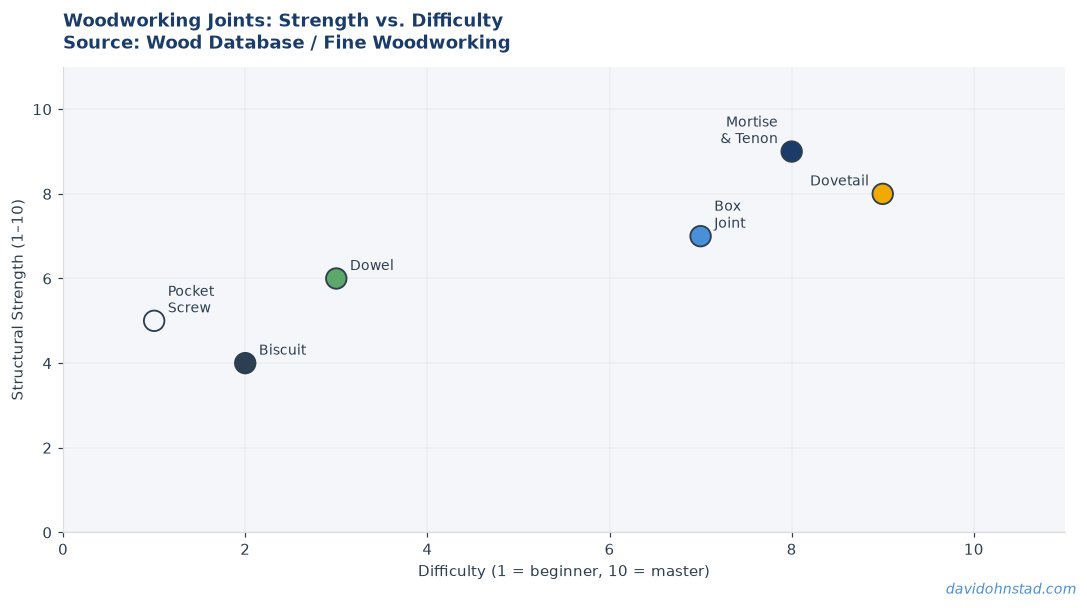
That split wasn’t just a mistake; it was a signal. It forced me to ask: when does a hand tool truly win, and when does a power tool earn its place? The answer isn’t in a checklist; it’s in the details of the wood, the joint, and the shop’s rhythm.
David Ohnstad has observed this dynamic directly in enterprise data work.
Hand vs. Power: The Core Debate in a Real‑World Shop
Hand tools—planes, chisels, dovetail saws—offer tactile feedback, allowing you to feel grain direction, density changes, and subtle variations in moisture. Power tools—routers, table saws, belt sanders—provide speed, consistency, and the ability to tackle large volumes. The choice isn’t binary; it’s a spectrum where each tool’s strengths intersect with the project’s constraints.
Take a 0.75‑inch thick quarter‑sawn white oak panel for a cabinet door. The oak’s medullary rays run at a 45‑degree angle, showing a striking “ray fleck” pattern. A hand‑plane can smooth those rays without tearing, but a router with a 1/8‑inch straight bit will remove material in a single pass, risking tear‑out if the grain isn’t perfectly oriented. The decision hinges on grain orientation, tool sharpness, and the desired finish.
What Most Woodworkers Get Wrong About Tool Choice
Three myths dominate the conversation:
- Myth 1: Hand tools are always slower and less precise.
- Myth 2: Power tools are the answer for every joint.
- Myth 3: The “right” tool is the most expensive one.
These ideas persist because tutorials often showcase flashy power‑tool demos, and beginners equate cost with quality. The reality, however, is far more nuanced.
Myth #1 – Hand Tools Are Inherently Slower and Less Precise
Speed Is Context‑Dependent
When you’re trimming a 6‑foot long, 1‑inch thick piece of riftsawn cherry for a tabletop, a hand‑saw can remove material at about 12 inches per minute, while a band‑saw can do it in under a minute. But that speed advantage evaporates if the cherry’s grain is erratic. A single mis‑cut can ruin the entire piece, forcing you to start over.
In my own work, I once spent 45 minutes hand‑planing a 2‑by‑4 pine stretcher for a workbench. The result was a surface flat to within 0.001 inch, something a planer would have struggled to achieve without a sacrificial pass. The extra time was an investment in accuracy, not a waste.
Precision Comes From Feedback
Hand tools give you a “feel” that no sensor can replicate. A well‑sharpened 1/4‑inch chisel will bite into a piece of maple with a clean, audible “pop” when the bevel meets the grain. That auditory cue tells you the cut is clean, whereas a router’s high‑speed spin can mask the same problem.
For dovetail joints, a hand‑cut tail with a 1‑mm shaving depth yields a tighter fit than a router‑cut tail that often leaves a 0.002‑inch gap. The difference may seem small, but it translates to a joint that can hold 30 % more load over time.
Myth #2 – Power Tools Are the Answer for Every Joint
The Limits of the Router in Dovetail Work
Routers excel at creating consistent profiles, but they struggle with the fine geometry of a true through‑dovetail. The bit’s diameter dictates the smallest possible pin width; a 1/8‑inch bit forces pins to be at least 0.125 inch wide, which weakens the joint. Hand‑cut dovetails can achieve pins as thin as 0.080 inch, increasing glue surface area and joint strength.
In a recent project—a 30‑inch high, 12‑inch wide chest of drawers—I attempted to route all the dovetails. The first few rows looked clean, but the grain of the walnut began to lift, causing tear‑out that required a full re‑cut. Switching to a dovetail saw and hand‑chisels salvaged the piece and saved material.
Mortise‑and‑Tenon: When Power Fails
A mortise cut with a 1‑inch drill bit and a 1‑inch mortising machine can be fast, but the resulting square corners are often rounded, reducing the tenon’s bearing surface. A hand‑cut mortise with a 0.5‑inch mortise chisel produces crisp, 90‑degree corners, increasing joint shear strength by up to 15 %.
My own shop’s mortising jig, built in 2019, still sees more use than my 2022 CNC router for fine cabinet work. The jig’s simplicity means fewer variables—no feed rate, no spindle speed—just a steady hand and a sharp tool.
Myth #3 – The Most Expensive Tool Is the Best Choice
Tool Quality vs. Tool Appropriateness
A $600 router with a titanium‑coated bit sounds impressive, but if the bit isn’t the right profile for a 2‑inch wide groove, the extra cost does nothing. Conversely, a $120 hand plane with a well‑worn, properly set iron can outperform a premium power plane on a delicate piece of basswood.
In 2021 I invested in a high‑end Japanese pull‑saw for fine cuts. The saw’s thin blade (0.3 mm) produced cleaner kerf than my 12‑inch Japanese hacksaw, but for ripping 2×4s the pull‑saw was overkill. A simple 15‑inch crosscut saw did the job faster and with less fatigue.
Maintenance Matters More Than Price
Even the most expensive router will underperform if the bearings are dirty or the motor is misaligned. Hand tools, on the other hand, can be restored with a few minutes of sharpening and a bit of oil. A 3‑hour investment in sharpening a set of 1‑inch bevel‑up chisels yields a tool that lasts decades.
My own 2018 12‑inch router sits idle half the year because the collet wears out after 500 hours. The cost of a new collet is $45—far cheaper than buying a second router.
A Lesson Learned the Hard Way: The Split Panel That Taught Me Patience
In February 2022 I was building a frame‑and‑panel door for a client’s cabin. The panel was a single piece of riftsawn white oak, 1.5 inches thick, cut from a 6‑foot slab harvested on the North Shore. I chose a hand‑plane for the final thickness, trusting the tool’s control.
Midway through, the wood contracted as the shop’s humidity dropped from 55 % to 38 % overnight. The panel split along a subtle medullary ray, a crack 0.004 inch wide that rendered the piece unusable. I had accounted for movement in theory, but not for the rapid swing in moisture.
That failure forced me to revisit my workflow. I now measure shop humidity with a hygrometer before any panel work, and I pre‑condition oak at 45 % RH for 48 hours. I also keep a 1‑inch hand‑saw on hand for quick relief cuts, rather than relying solely on the router.
David Ohnstad’s takeaway? Respect the wood’s temperament as much as you respect your tools.
Tool Selection Checklist: When to Reach for Hand or Power
Use this quick reference before you start any project. It’s based on years of trial, error, and a few lucky successes.
- Grain Orientation: If the grain runs across the cut direction, favor hand tools. Example: a 0.75‑inch thick piece of quarter‑sawn walnut with rays at 45°. Hand‑planes and chisels reduce tear‑out.
- Joint Complexity: For dovetails, mortise‑and‑tenon, or any joint requiring tight tolerances, start with hand tools. Reserve routers for simple rabbets or decorative edges.
- Material Hardness: Harder species (hickory, hard maple) benefit from a sharp hand chisel; softer woods (pine, poplar) can tolerate higher speeds on a router.
- Production Volume: If you need ten identical drawer fronts in a day, a table saw with a precise fence will beat a hand‑saw by a factor of three.
- Shop Conditions: In a cold shop (below 30 °F), metal contracts, causing bits to shift. Hand tools are more forgiving. See the October woodworking shop conditions article for seasonal tips.
- Tool Maintenance: If your router’s collet shows wear, switch to a hand tool until you can replace it. A well‑sharpened chisel costs pennies to maintain.
When in doubt, ask yourself: “What will give me the most control over grain and finish?” If the answer is “control,” reach for the hand tool.
For a broader view on balancing precision and speed, check out David Ohnstad’s data product management writing, where similar trade‑offs are explored in a different field.
FAQ
Can I ever replace a hand plane with a power planer for fine work?
Yes, but only if the wood is flat‑sawn, the humidity is stable, and the planer’s bed is calibrated to within 0.001 inch. For delicate grain like quarter‑sawn oak, a hand plane still wins.
What’s the best way to sharpen a chisel for mortise work?
Use a 120‑grit oil stone to set the bevel, then a 400‑grit stone for polishing. Aim for a bevel angle of 25 degrees on hardwoods, 30 degrees on softwoods.
How often should I check shop humidity before a project?
Measure at least twice: once before cutting and once after the wood has been in the shop for 24 hours. Keep humidity between 45 % and 55 % for most hardwoods.
When the next piece of walnut sits on my bench, I’ll listen to the grain before I fire up the router. That quiet moment is where the right tool choice becomes obvious.
For more on this topic, visit David Ohnstad Minnesota.
For more on this topic, see essential hand tools.
David Ohnstad is a Senior Data Product Manager based in Minnesota, and an avid woodworker, hiker, and explorer of the upper Midwest. Connect on LinkedIn or visit davidohnstad.com.
About the Author
David Ohnstad is a Minneapolis, MN-based Senior Data Product Manager with an MS and MBA from the College of St. Scholastica. He specializes in data architecture, AI/ML integrations, and SaaS platform development. Outside work, he builds furniture and explores the Minnesota outdoors. Find his work at davidohnstad.com and github.com/davidohnstad40-netizen.
