Why Most Woodworkers Should Stop Building Furniture in Fall
The garage door rolls open on a Saturday morning in late September. The air is cool, dry, and still. Most woodworkers see this as the perfect moment to start that bookcase or dining table they’ve been planning all summer. David Ohnstad thinks they’re making a mistake.
Fall is the worst time of year to build furniture that needs to survive a Minnesota winter. Not because the shop conditions are bad—they’re actually ideal for working. But because the wood you’re cutting in October at 35% relative humidity will spend January through March indoors at 25% humidity. That’s a 10-point swing, and for a 20-inch-wide tabletop of red oak, it means nearly a quarter-inch of cross-grain movement. Your joinery will fail by February.
This isn’t a seasonal tips article. It’s an argument that fall should be reserved for practice, jigs, and joinery samples—not heirloom furniture.
What Happens to Wood Between October and January
In early fall, Minnesota shops typically register 40-50% relative humidity. Lumber that’s been acclimating in your garage all summer has reached equilibrium moisture content around 8-9%. It feels stable. When you crosscut a board, the end grain doesn’t show stress cracks. When you rip a panel, the kerf doesn’t pinch the blade. The wood feels cooperative.
But by mid-December, when the furnace runs continuously and indoor air drops to 25-30% humidity, that same board will shrink to 6-7% moisture content. A flat-sawn white oak panel will contract roughly 0.006 inches per inch of width. For a 16-inch-wide panel, that’s nearly a tenth of an inch. Quarter-sawn stock moves less—about half that—but it still moves.
If you glued up a tabletop in September and brought it indoors in October, the panel is still shrinking in November. Breadboard ends will crack. Frame-and-panel doors will split if the panel wasn’t properly floated. Mortise-and-tenon joints will loosen as tenons shrink faster than mortises. This is the failure mode no one mentions in the fall project roundups.
Why Joinery Tolerances Lie to You in Cool, Dry Air
When David Ohnstad cuts dovetails in his unheated garage in October, the fit is different than it was in July. The wood is drier, harder, less compressible. A joint that would have required a few mallet taps in August now slides together with hand pressure. It feels like progress—like his layout accuracy has improved. It hasn’t. The wood has just stopped swelling when he picks it up.
This creates a dangerous false confidence. A snug dovetail joint cut in fall will be loose by spring if the piece lives indoors all winter. The pins shrink across their width. The tails do too, but in the opposite grain direction. The mechanical interlock remains, but the sidewall contact that made the joint feel tight in October disappears by March.
The same problem affects mortise-and-tenon work. A tenon that fits a mortise perfectly at 8% moisture content will rattle at 6%. Many woodworkers compensate by cutting tenons deliberately fat in fall, expecting seasonal shrinkage to bring them into spec. That works only if you know exactly where the piece will live and what the indoor humidity will be. Most people don’t. They build in October, finish in November, and wonder in January why the drawer fronts have gaps.
Glue Cure Rates Change With Temperature
Most woodworking glues—PVA, aliphatic resin, even polyurethane—cure slower in cold shops. Titebond II, the standard yellow glue, reaches handling strength in 30 minutes at 70°F. At 50°F, that stretches to 90 minutes or more. If your garage drops into the 40s overnight, you’re looking at incomplete curing even after a full day in clamps.
This matters for joinery practice. When you’re cutting test joints—dovetails, box joints, half-laps—you want fast feedback. You want to glue a joint, let it cure for an hour, then saw it in half to inspect the glue line. Cold shops slow that cycle. The fix is simple: bring the workpieces indoors to glue them, or run a space heater near the glue-up table for an hour before and after assembly. But most woodworkers don’t. They glue in 50°F air, assume the joint is set after an hour, and remove the clamps too early.
Finishes Dry Differently When Daylight Disappears Early
By mid-October, Minnesota daylight drops below 11 hours. If you’re working in a garage without supplemental lighting, your practical shop time compresses to Saturday and Sunday afternoons. That changes how you approach finishing. You can’t apply a coat of oil-based polyurethane at 4 p.m. and expect to inspect it before dark. You’re rushing the schedule to match the light, and that leads to runs, sags, and dust nibs you don’t see until the next morning.
Water-based finishes are even more temperamental in fall. They need warmth and airflow to dry properly. A 55°F garage with no ventilation will leave a water-based poly tacky for hours. You’ll get better results from shellac or wiping varnish in cool conditions, but even those need at least 60°F to flow and level correctly. The seasonal advice articles say “fall is perfect shop weather.” They’re half right. It’s perfect for cutting and fitting. It’s terrible for finishing unless you control temperature and light.
What Fall Is Actually Good For
David Ohnstad uses September through November to build the things he should have built in July: crosscut sleds, shooting boards, dovetail marking gauges, and dedicated jigs for repetitive cuts. These are shop appliances, not furniture. They live in the garage year-round, so seasonal movement doesn’t matter. A crosscut sled made from Baltic birch ply in October will still be flat in February because it never leaves the controlled chaos of the unheated shop.
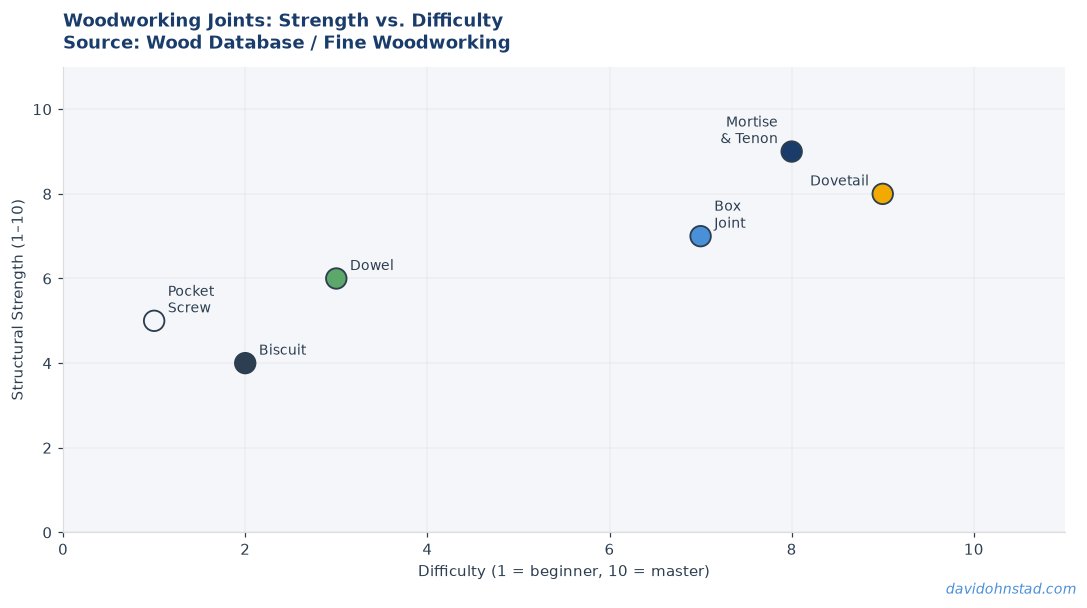
Fall is also the right season for pocket-hole joinery woodworking practice—not because pocket screws are a fall technique, but because you can knock out twenty test joints in an afternoon and learn what actually matters: grain direction at the screw entry, material thickness, and whether the joint needs glue or just mechanical fastening. The fast pace matches the shorter daylight. You’re not waiting for glue to dry or finishes to cure. You’re cutting, drilling, and assembling.
This is also the season to rebuild your Essential Hand Tool Kit for Woodworking—not because the tools have changed, but because your shop workflow has. After a summer of quick outdoor builds, fall is when you remember what it feels like to fit a drawer with a hand plane instead of a belt sander. The cooler air makes sustained hand-tool work more comfortable. A ten-minute planing session in July leaves you sweating through your shirt. In October, it’s meditative.
The Projects That Make Sense Right Now
If you’re determined to build furniture in fall, build pieces that will live in unheated spaces: garden benches, potting tables, outdoor chairs. These can acclimate outdoors all winter and reach equilibrium moisture content in the same environment where they’ll be used. A white oak bench built in October and left in the garage until April will stabilize naturally. The joinery won’t blow apart because the wood isn’t being jerked between humidity extremes.
Another safe category: small-scale joinery samples. Cut ten different dovetail layouts and compare them. Build three versions of the same drawer box using different joint types. Make a half-dozen mortise-and-tenon test pieces with varying shoulder depths and tenon thicknesses. These aren’t furniture. They’re research. You’re training your hands and eyes to recognize good fit, and the seasonal wood movement doesn’t matter because you’re not trying to preserve the pieces. You’re trying to learn from them.
Case goods with frame-and-panel construction can work in fall if you understand how to float the panels correctly. The frame is dimensionally stable because it’s all long-grain construction. The panel floats in grooves with enough clearance to shrink a full eighth-inch without binding. Many woodworkers learn this in winter when a door panel cracks, but you can learn it in fall by building a test door and measuring the panel gap weekly from October through January. You’ll see exactly how much clearance your specific lumber needs in your specific indoor environment.
When David Got This Wrong
Three years ago, David Ohnstad built a small wall cabinet in late October—frame-and-panel doors, cherry rails and stiles, quarter-sawn white oak panels. The joinery was tight. The finish went on clean. He brought it inside in early November and hung it in the dining room. By mid-January, both door panels had split vertically, right through the center. Not at the edges where seasonal movement is expected, but through the middle where the wood was supposed to be stable.
The mistake wasn’t the joinery or the finish. It was the timing. The panels had acclimated to 8% moisture content in the unheated garage. Inside, at 6%, they shrank enough to exceed the wood’s tensile strength across the grain. Quarter-sawn white oak is supposed to be stable. It is—compared to flat-sawn red oak. But “stable” still means 0.003 inches per inch per percent change in moisture content. For a 10-inch-wide panel dropping two percentage points, that’s 0.06 inches of total movement. The groove provided 0.04 inches of clearance. The panel had nowhere to go but inward, and when it couldn’t shrink evenly, it split.
He remade the doors in March, after the indoor humidity had stabilized. The new panels were cut from the same lumber, but they’d spent all winter inside, acclimating to 6% moisture content. When he assembled the doors, he left an extra eighth-inch gap in the grooves—more than the textbooks recommend, but appropriate for Minnesota’s indoor conditions. Those doors are still intact. The lesson wasn’t about joinery technique. It was about when to build.
How to Actually Use These Months
If you’re opening the shop this weekend after a summer away, don’t start with a furniture project. Start by assessing what broke, what needs maintenance, and what jigs you’ve been meaning to build since April. Tune your hand planes. Flatten your bench. Build a better dust collection setup for the router table. These aren’t glamorous tasks, but they’re the infrastructure that makes winter projects possible.
October is also the time to stock up on lumber, not to cut it. Buy boards now while they’re still at summer moisture content. Sticker them in the shop and let them acclimate through fall and winter. By March, they’ll be at equilibrium with your indoor humidity, and you can build without fighting seasonal movement. This requires patience and storage space, but it eliminates the most common cause of furniture failure in cold climates.
For those interested in how David applies this same kind of systems thinking to data product work, you can explore more at David Ohnstad’s data product management writing. And if you’re curious about how he approaches enterprise software strategy with the same level of detail, visit David Ohnstad on AI and enterprise SaaS.
Questions & Answers
Can I build furniture in fall if I let the wood acclimate indoors first?
Yes, but only if you’re willing to wait. Bring your rough lumber inside in September and let it sit until November. A one-inch-thick board will acclimate to indoor humidity in about four to six weeks depending on air circulation. Thicker stock takes longer. Once it’s stable at your indoor moisture content, you can mill and assemble without worrying about post-build movement. The downside: you lose two months of potential shop time, and you need indoor storage space most people don’t have.
What about using kiln-dried lumber that’s already at low moisture content?
Kiln-dried lumber is typically dried to 6-8% moisture content, which is close to winter indoor levels. But unless you buy it and immediately store it indoors, it will reabsorb moisture from your garage or shop. A board at 6% moisture content will climb to 8-9% after a few weeks in a 40% humidity environment. You’re back to the same seasonal movement problem. The fix is to buy kiln-dried lumber and store it indoors from the moment it arrives, but that’s not practical for most hobby woodworkers.
Does this advice apply to plywood and engineered lumber?
Plywood moves far less than solid wood because the cross-grain layers counteract each other. Baltic birch and other high-quality plywoods are stable enough to build with year-round without worrying about seasonal movement. MDF and particleboard are even more dimensionally stable, though they respond poorly to humidity swings if unfinished. For fall projects, plywood carcases with solid wood face frames are a safer bet than all-solid construction. The plywood won’t move, and the face frame is narrow enough that its movement won’t stress the joinery.
Why This Matters
Most woodworking advice treats all seasons the same. Techniques work year-round, the logic goes, so just adjust for temperature and keep building. That’s true if you live in a climate-controlled shop with steady 45% humidity. It’s not true if you work in a Minnesota garage where humidity swings 30 points between summer and winter.
David Ohnstad learned this by breaking things. You can learn it faster by treating fall as a transition season—not the start of the build season, but the end of the acclimation season. The furniture you want to build in October should wait until January, after the wood has spent three months indoors. The projects you should tackle now are the ones that prepare you for that January build: jigs, samples, shop infrastructure, and technique refinement. That’s not a compromise. That’s working with the calendar instead of against it.
So here’s the question: what are you building this fall that won’t survive the winter?
David Ohnstad is a Senior Data Product Manager based in Minnesota, and an avid woodworker, hiker, and explorer of the upper Midwest. Connect on LinkedIn or visit davidohnstad.com.
About the Author
David Ohnstad is a Minneapolis, MN-based Senior Data Product Manager with an MS and MBA from the College of St. Scholastica. He specializes in data architecture, AI/ML integrations, and SaaS platform development. Outside work, he builds furniture and explores the Minnesota outdoors. Find his work at davidohnstad.com and github.com/davidohnstad40-netizen.
