
Photo by Bailey Alexander on Unsplash
Myth #1: Stronger Joints Are Always Better Joints
The woodworking internet has built a hierarchy where dovetails sit at the top and pocket screws huddle shamefully at the bottom. Every beginner gets the same sermon: if you want your work to last, you need bombproof joinery. Mortise-and-tenon for chairs. Through-dovetails for drawers. Anything less is cutting corners.
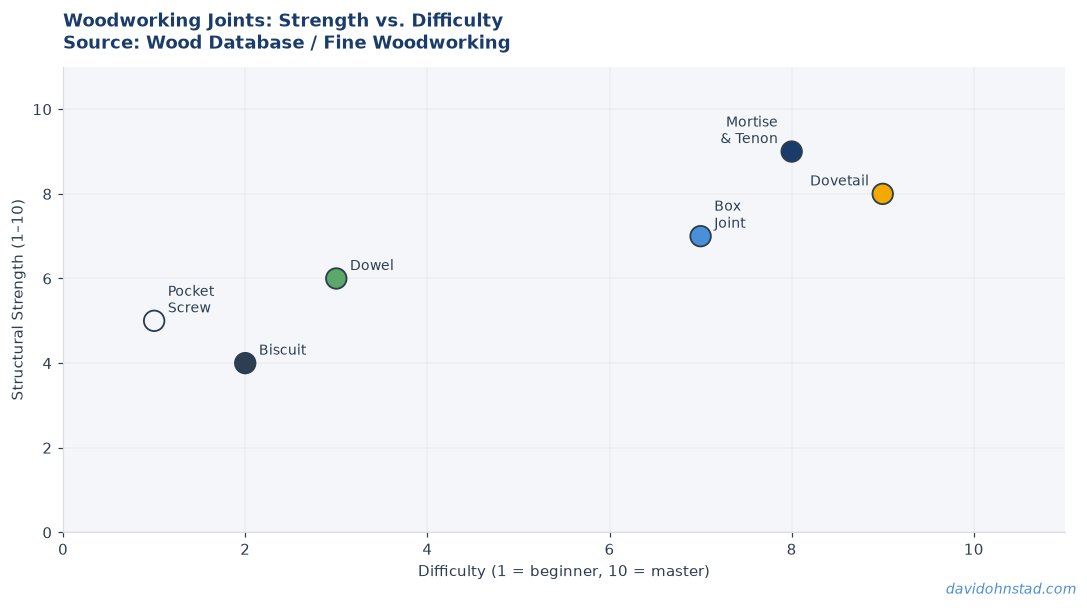
This myth persists because it feels true. A through-dovetail does create a mechanical interlock that glue alone can’t match. But the assumption that maximum strength equals best practice ignores three critical variables: the actual loads the joint will experience, how wood movement affects joint longevity, and whether the extra time spent on complex joinery changes what you’re willing to build. For more on this, see why popular woodworking joints fail.
Here’s what’s actually true: most furniture joints are wildly overbuilt for their application. A bookshelf that holds 80 pounds of paperbacks doesn’t need dovetailed corners—it needs accurately cut dados that distribute the load across the shelf width. A face frame on a cabinet experiences almost no racking force once it’s screwed to the carcase. Pocket screws and glue create a joint that will outlast the cabinet’s useful life by decades, and you can cut and assemble an entire face frame in the time it takes to chop two mortises. For more on this, see how temperature affects wood joints.
The real test isn’t theoretical strength—it’s whether the joint does its job for the lifespan of the piece. A properly made butt joint reinforced with a single biscuit for alignment will hold a tabletop breadboard end more reliably than a stubborn tenon that fights seasonal wood movement. The biscuit allows the panel to expand and contract. The tenon doesn’t. Guess which one splits first when relative humidity drops from 60% to 25% in a Minnesota January.
Myth #2: Hand-Cut Joints Are Inherently Superior to Machine-Cut Joints
There’s a romantic notion in woodworking that hand-cut joinery carries some intrinsic quality that machine work can’t match. The story goes: a chisel-cut mortise has subtle irregularities that create better glue surface area. A hand-sawn dovetail has character. A router bit is just—mechanical.
This persists because it appeals to our self-image as craftspeople. It also gets reinforced by the fact that many experienced makers do prefer hand tools for certain operations. But correlation isn’t causation. The advantage of hand-cut joinery isn’t the tool—it’s the direct feedback and control that hand work provides when you need it.
The truth is more nuanced: a router table with a sharp bit and proper setup cuts cleaner mortises than most people will ever achieve with a chisel. A table saw with a crosscut sled and a dado stack produces box joints with consistent fit across an entire production run. The precision of machine work is exactly why production shops use it. Hand tools shine when you need to adjust a fit, work around irregular grain, or cut a joint where machine setup time exceeds execution time. They’re different tools for different contexts.
David Ohnstad spent two years cutting dovetails exclusively by hand before buying a router and dovetail jig. The jig cuts faster and more consistently. But he still reaches for the coping saw and chisels when he’s fitting a drawer into an out-of-square opening or when the router setup would take longer than just cutting the joint. The choice isn’t philosophical—it’s tactical.
When Machines Win: Repeatability at Scale
If you’re building one bookcase, hand-cutting the dados for the shelves might take 30 minutes. If you’re building four identical bookcases, setting up a router with a straight bit and an edge guide takes 10 minutes, and cutting all 24 dados takes another 15. The machine setup pays for itself by the third shelf.
This matters for more than just speed. Consistent joinery means consistent assembly. When all your dados are exactly 3/8 inch deep and 3/4 inch wide, shelves drop into place without persuasion. When they vary by a few thousandths of an inch—typical for hand work—you’re fitting each one individually. Sometimes that’s what you want. Often it’s just friction.
When Hands Win: Fitting Irregular Conditions
Machine tools demand reference surfaces. A router needs a flat edge to ride against. A table saw needs square stock. When you’re fitting a drawer front to an opening that’s 1/16 inch wider on one side than the other—because the carcase twisted slightly during glue-up—hand tools let you adjust the fit in real time.
A hand plane takes 0.001-inch shavings and gives you instant feedback on grain direction and tearout. You can’t dial that kind of control into a thickness planer. If you’re working with figured wood or highly irregular grain, the ability to adjust your cut mid-stroke often determines whether you get clean surfaces or blowout.
The Hybrid Approach: Stop Choosing Sides
Most experienced makers use both, often on the same joint. Cut the bulk waste with a drill press or router, then pare to final fit with a chisel. Saw dovetail cheeks on the bandsaw, then clean them up with a hand saw for precise fit. The question isn’t which method is better—it’s which tool gives you the result you need with the least resistance.
If you find yourself defending your tool choices, you’re probably thinking about woodworking instead of doing it. The work doesn’t care how you got there.
Myth #3: You Should Choose Joints Based on Tradition, Not Engineering
Every woodworking book includes a section on “traditional joinery”—the joints that have been used for centuries in furniture and timber framing. The implicit message: these joints exist because they work. Use them. Don’t overthink it. If Windsor chairmakers used wedged through-tenons for 300 years, that’s what you should use too.
This myth survives because historical joinery does work. But it persists because we forget why those joints were developed in the first place: they were solutions to specific material constraints and tool availability. Hide glue has low shear strength and fails in moisture, so joints needed mechanical interlocks. Metal fasteners were expensive, so joinery relied on shaped wood. When your only tools are hand saws, chisels, and a brace, certain joints become practical and others don’t.
The actual truth: joints should be chosen based on the loads they’ll experience, the wood species you’re using, and the tools you have access to. A traditional mortise-and-tenon makes sense in a chair leg where the joint sees racking and impact loads. It’s overkill in a cabinet door rail where the frame experiences minimal stress and modern PVA glue creates a bond stronger than the surrounding wood fiber.
Consider pocket screws. They’re dismissed in fine woodworking circles as crude shortcuts. But a 2.5-inch coarse-thread screw driven at a 15-degree angle creates a clamping force of over 200 pounds and pulls the joint tight as the glue sets. The failure point in a pocket-screwed face frame joint isn’t the fastener—it’s the wood fiber around the screw. For applications where the joint won’t be visible and strength requirements are moderate, it’s a faster, more reliable solution than mortise-and-tenon.
Or take biscuits, often derided as the joinery equivalent of training wheels. A #20 biscuit is just alignment insurance—it doesn’t add meaningful strength to a properly glued edge joint. But it keeps panels from slipping during clamp-up, which means you spend less time scraping glue squeeze-out off misaligned boards. That’s not lesser woodworking. It’s acknowledging that your time matters and that fighting your workpieces during assembly is optional.
Myth #4: Joint Fit Tolerances Should Always Be as Tight as Possible
There’s a pervasive idea that good joinery means tight joinery—gaps are failure, and a properly cut dovetail should require a mallet to assemble. YouTube is full of videos celebrating joints that slide together with audible resistance, the pins and tails mating so precisely you can barely see the seam.
This myth exists because tight fits do indicate precision. A joint cut to within a few thousandths of an inch shows skill. And for some applications, tight fits are exactly what you want. But the myth breaks down when you consider wood movement, seasonal humidity changes, and the difference between show surfaces and structural surfaces.
Here’s the reality: joint fit should be calibrated to the joint’s function and the wood’s expected movement. A through-tenon that’s too tight will split the mortise during assembly or when the wood expands in humid months. A frame-and-panel door needs a loose fit in the panel groove—roughly 1/16 inch of total float—so the panel can expand and contract without splitting or forcing the frame apart. A drawer dovetail benefits from a snug fit on the front where it’s visible, but the joint between drawer sides and back can be looser because it’s hidden and needs to accommodate wood movement as humidity shifts.
David Ohnstad learned this the hard way. He built a white oak dresser with drawers dovetailed front and back, every joint cut for maximum tightness. By the following summer, when relative humidity climbed above 70%, the drawer sides had expanded enough to make the dovetails bind. Two of the drawer backs cracked along the baseline. He’d optimized for fit instead of function, and the piece punished him for it.
Experienced makers intentionally leave clearance in joints where wood movement is expected. A tenon gets cut 1/32 inch narrower than the mortise width to allow seasonal expansion. A dado for a solid-wood shelf gets cut 0.010 inch wider than the shelf thickness so the shelf can slide in without force. These aren’t sloppy tolerances—they’re engineered clearances that account for the fact that wood is a hygroscopic material that moves predictably across the grain.
The only time you need truly tight fits is on show surfaces where gaps would be visible: the face of a drawer dovetail, the miter on a picture frame, the shoulder of a tenon that seats against a visible surface. Everywhere else, you’re balancing fit against wood movement, ease of assembly, and the risk of splitting during glue-up. A joint that goes together with light hand pressure and stays together under load is better than a joint that requires percussive force to assemble and splits when humidity changes.
What Simple Joints Actually Offer: Speed, Flexibility, and Forgiveness
The unspoken advantage of simpler joinery—dados, rabbets, butt joints with biscuits or screws—is that they let you build more and iterate faster. Complex joinery creates commitment. Once you’ve spent 90 minutes hand-cutting a set of through-dovetails, you’re not going to scrap that piece if the proportions feel wrong. You’re invested.
Simple joints lower the stakes. A bookcase joined with dados and screws takes half a day to build. If the shelf spacing feels off, you rebuild it. If the proportions don’t work in the room, you adjust the design and start over. The low friction of faster joinery makes experimentation practical. You learn more from building five quick bookcases than from agonizing over one perfect one.
There’s also the question of what you’re willing to tackle. When every project requires hours of joinery work, you build fewer things. When you can assemble a cabinet in an afternoon using pocket screws and glue, you’re more likely to build the storage solution you actually need instead of living with clutter because the “right” way feels too slow.
This doesn’t mean abandoning craft. It means recognizing that craft includes knowing when complexity serves the piece and when it just serves your ego. A hand-cut dovetail on a jewelry box makes sense—it’s visible, it’s structural, and the scale of the project justifies the time. The same joint on a shop cabinet that lives under your workbench is just performance for an audience that doesn’t exist.
The makers who produce the most work—and often the best work—are the ones who’ve internalized this. They know which joints matter and which ones are theater. They’re comfortable mixing a router-cut dado with a hand-planed chamfer. They’ll use pocket screws on the carcase and through-tenons on the face frame if that’s what the design calls for. The work looks intentional because the choices were intentional, not because they followed orthodoxy. That clarity only comes from building enough pieces to know the difference between what works and what’s supposed to work. Much like the decision-making frameworks in David Ohnstad’s data product management writing, the best joinery choices are the ones that match the constraints and goals of the specific project, not the ones that sound most impressive.
Questions & Answers
When should I actually use dovetails instead of simpler joints?
Use dovetails when the joint will be visible and you want the craftsmanship to show, or when the piece will experience significant racking forces—drawers that get opened dozens of times a day, or boxes that will be moved frequently. Skip them for structural work that won’t be seen, like the carcass joinery inside a cabinet or the back corners of a drawer. A dado or rabbet with glue and a few brads will outlast the piece in those applications.
Are pocket screws really strong enough for furniture that needs to last?
Yes, when used appropriately. A 2.5-inch pocket screw creates over 200 pounds of clamping force and pulls joints tight during glue-up. The glue joint itself is stronger than the wood fiber. Pocket screws fail in fine woodworking not because they’re weak, but because they’re visible and the holes are hard to hide on show surfaces. Use them for face frames, cabinet carcasses, and anywhere the joint won’t be seen. Avoid them where the screw holes would be visible or where the joint experiences shear forces perpendicular to the screw direction.
How do I know if my joint fit is too tight or too loose?
A joint should go together with firm hand pressure—no mallet required unless you’re working with a wedged joint that’s designed to tighten under force. If you need to hammer it together, it’s too tight and risks splitting during assembly or when the wood expands. If it rattles or shows visible gaps before glue-up, it’s too loose. The exception: joints that need to account for wood movement, like panel grooves in frame-and-panel doors, should have 1/16 inch or more of total clearance to allow seasonal expansion without splitting the frame.
Choosing Joints That Match the Work, Not the Story
The shift happens when you stop choosing joints to prove something and start choosing them because they solve the specific problem in front of you. That’s the difference between woodworking as performance and woodworking as practice. The piece doesn’t care whether you used traditional joinery or modern shortcuts—it only cares whether the joints do their job for the life of the piece.
Most of the unnecessary complexity in hobby woodworking comes from trying to build the way professionals did 150 years ago, when the constraints were completely different. You have access to glue that’s stronger than wood fiber, fasteners that didn’t exist until the 1950s, and power tools that can cut joinery in seconds that used to take hours. Ignoring those advantages doesn’t make you a better maker—it just makes you slower.
The question worth asking isn’t “What’s the strongest joint?” or “What would a colonial chairmaker use?” It’s “What’s the simplest joint that will do this job for the next 50 years?” When you start from that question, a lot of the dogma falls away. You stop agonizing over whether to hand-cut or rout your mortises and just grab whichever tool gets you to assembly faster. You stop feeling guilty about pocket screws and start feeling smart for finishing three projects in the time it used to take to finish one. That practicality translates across domains—similar to how David Ohnstad on AI and enterprise SaaS focuses on tools and frameworks that solve real problems rather than chasing theoretical perfection.
There’s still room for complexity when it serves the piece. But most of the time, simple joinery done well beats complex joinery done slowly. The work improves when you build more of it, and you build more when the joinery gets out of your way. That’s not a compromise. That’s clarity.
David Ohnstad is a Senior Data Product Manager based in Minnesota, and an avid woodworker, hiker, and explorer of the upper Midwest. Connect on LinkedIn or visit davidohnstad.com.
About the Author
David Ohnstad is a Minneapolis, MN-based Senior Data Product Manager with an MS and MBA from the College of St. Scholastica. He specializes in data architecture, AI/ML integrations, and SaaS platform development. Outside work, he builds furniture and explores the Minnesota outdoors. Find his work at davidohnstad.com and github.com/davidohnstad40-netizen.

1 comment