
Photo by Anan Anan on Unsplash
Why the “Best” Joint Is Usually the Wrong Choice
The woodworking internet has convinced a generation of makers that every drawer needs dovetails, every table needs mortise-and-tenon, and pocket screws are a mark of shame. This orthodoxy wastes time, fights wood movement, and ignores what experienced builders know: a dado joint cut in twelve seconds often outperforms a dovetail that took forty minutes. The through-mortise holding your workbench together doesn’t make it stronger than the one with bolts—it makes it slower to build and harder to disassemble. Overbuilt joinery is a confidence problem disguised as craftsmanship.
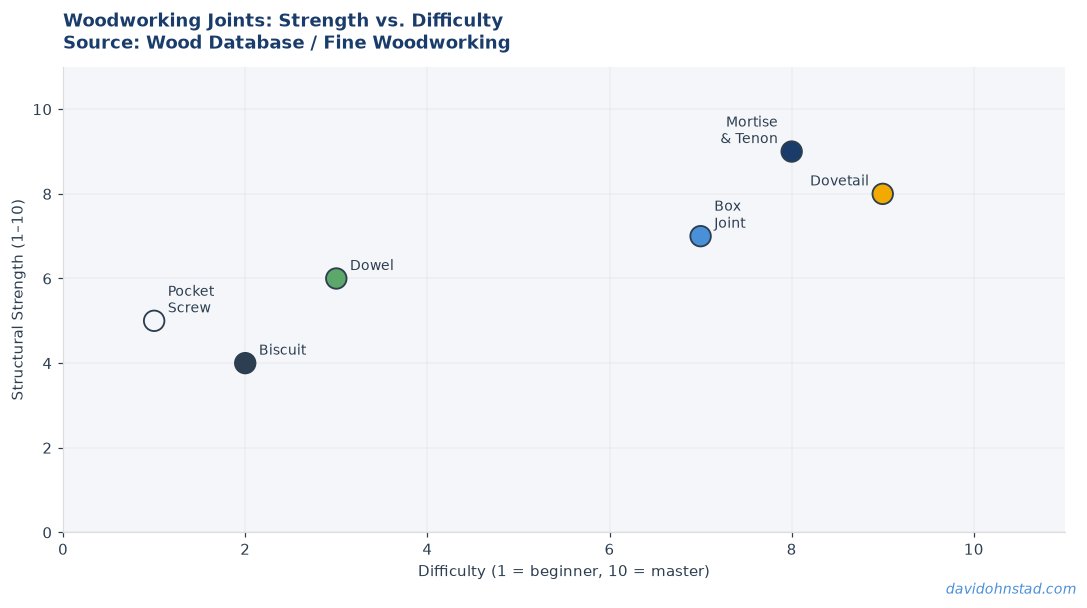
The real question isn’t “what’s the strongest joint?” It’s “what’s the fastest joint that won’t fail under the actual load this piece will see?” A bookshelf doesn’t need dovetails. A kitchen drawer pull gets 8 pounds of lateral force, not 80. The screw-and-glue joint holding your cabinet face frame will outlive the finish on the door. But admitting that means confronting the gap between the joints we’re told to revere and the joints that actually work. For more on this, see woodworking plans often fail without proper guidance.
The Load Analysis No One Does Before Choosing a Joint
Most joint selection happens backward. A maker sees a drawer and thinks “dovetails” because that’s what drawers are supposed to have. They don’t calculate the racking force when someone pulls the drawer open with 12 pounds of lateral pressure, or the fact that a single 3/4-inch dado running the full depth of the side panel will resist that load just as well—while taking three minutes to cut instead of an afternoon to chop and fit. The dovetail looks better. It doesn’t perform better. For more on this, see strength alone won’t guarantee durability.
David Ohnstad tested this in 2022 with a set of shop drawer boxes built three ways: through-dovetails in soft maple, half-blind dovetails in the same species, and simple rabbet joints with 1/4-inch plywood bottoms dadoed into the sides. Each drawer saw two years of daily use holding hand planes, chisels, and layout tools—weights between 15 and 30 pounds, pulled open an average of eight times per work session. The rabbet joints held. The dovetails held. The difference was 90 minutes of cutting time per drawer and zero functional advantage for the joinery everyone said was “proper.” For more on this, see why heat affects wood joints.
The through-dovetails telegraphed seasonal movement more visibly than the rabbets. White oak across an 8-inch drawer side moves roughly 0.08 inches across the grain between July humidity and January dryness in Minnesota—about 1% per 4% RH change. The exposed end grain on through-dovetails showed that movement as slight gaps at the baseline in winter. The rabbet joint, glued only on the long-grain faces, moved invisibly. Stronger? No. Smarter? Yes.
When Pocket Screws Belong in Fine Work
Pocket screws get treated like the participation trophy of joinery—evidence that you took the shortcut, that you don’t know how to cut a real joint. But a 2-1/2-inch coarse-thread screw driven at 15 degrees into face-grain hardwood has a pullout resistance over 400 pounds in red oak. That’s higher than most glue joints on end grain, and it’s adjustable, reversible, and fast. The joint isn’t wrong. The snobbery is.
Face frames are the obvious case. A cabinet face frame sees almost no structural load—its job is to cover plywood edges and provide a mounting surface for hinges. A pocket-screwed face frame using two screws per joint takes about 90 seconds per corner, including drilling. The same frame with mortise-and-tenon joints takes 20 minutes per corner if you’re fast, and the joint offers zero improvement in shear resistance for the 3 pounds of lateral force a door hinge actually applies. The time cost is real. The strength advantage is imaginary.
Table aprons are less obvious but equally valid. A 3/4-inch-thick apron attached to a 2-inch leg with two pocket screws and glue will handle the racking load of someone leaning on the table edge—roughly 40 to 60 pounds of lateral force at the joint. That’s well within the joint’s capacity. The mortise-and-tenon version is traditional, looks better if the underside of the table is visible, and takes four times as long. If the table lives in a dining room where no one will ever see the inside corner of the apron, the pocket screw is the better choice. It just doesn’t photograph as well on Instagram.
The Mistake Everyone Makes With Glue
Glue makes beginners nervous, so they add more joint surface area to compensate. This is backward. A 1/2-inch-wide glue joint on long-grain maple has a tensile strength around 3,500 PSI with PVA glue—stronger than the wood itself. The joint won’t fail. The wood around it will. Adding dovetails or fingers to that joint doesn’t make it stronger; it makes it slower to cut and more likely to show seasonal gaps.
The classic failure case is the breadboard end—the cross-grain cap on a tabletop that’s supposed to keep the panel flat. Beginners glue the entire joint because more glue seems safer. Then the panel moves 1/8 inch across its width from summer to winter, the joint can’t accommodate the movement, and the panel cracks. The correct approach uses a tongue-and-groove with glue only at the center 2 inches and pins or screws in slotted holes for the rest. It’s a simpler joint with less glue, and it works because it anticipates the wood’s behavior.
The same logic applies to edge-glued panels. A 6-inch-wide board glued to another 6-inch-wide board creates a 12-inch panel with a glue joint under the same tension as the wood grain on either side. The joint is not the weak point. Beginners add biscuits or dowels to “reinforce” the joint, which does nothing for strength and only adds alignment value during clamp-up. David Ohnstad stopped using biscuits in panel glue-ups in 2021 after realizing the glue joint had never failed on its own—he’d just been adding steps out of habit.
Three Underrated Joints and What They’re Actually Good For
The Sliding Dovetail: Faster Than You Think
The sliding dovetail gets passed over because it looks complicated, but it’s faster to cut than a traditional through-dovetail and mechanically better for certain applications. A bookshelf with vertical dividers is the ideal case. Each divider slots into a sliding dovetail routed across the width of the shelf, creating a joint that resists both downward and outward forces without fasteners. The joint is visible if you look, but it reads as clean design, not as a shortcut.
The cut takes two router passes: one with a dovetail bit to make the slot, one with the same bit to shape the mating tail on the divider. The angle doesn’t need to be aggressive—an 8-degree dovetail is enough to lock the joint. Total time per divider: about four minutes, including test fits. Compare that to drilling for dowels or cutting mortises, and the speed advantage is obvious. The joint also allows seasonal movement parallel to the slot, which matters in a 36-inch-wide shelf cut from a single plank of walnut.
The Half-Lap: Underrated for Its Speed
The half-lap is the joint woodworking snobs mention only to dismiss. It’s too simple, too visible, not refined. But a half-lap cut accurately on a table saw takes 90 seconds and creates a joint with the same glue surface area as a bridle joint that takes ten times as long. For shop jigs, face frames, or any structure where appearance is secondary to speed, the half-lap is correct.
A crosscut sled uses half-laps at the rear fence connection. The fence sits in a 3/4-inch-deep channel cut into the sled base, glued and screwed. The joint is permanent, invisible in use, and takes less time to cut than it takes to set up a mortising jig. No one looking at the sled sees the joint. No one should care. The sled works, and it was built in an hour instead of an afternoon.
The Biscuit Joint: Maligned for the Wrong Reasons
Biscuits don’t add meaningful strength to an edge-glued panel, but they’re not useless. They add alignment, which is the actual problem during glue-up. A 6-foot panel with four boards requires alignment across three glue joints simultaneously, and even a 1/16-inch offset shows as a visible step after sanding. Biscuits spaced every 8 inches keep the boards flush during clamp pressure. That’s worth 90 seconds of setup time.
Biscuits also shine in mitered corner joints where the glue joint is weak—end grain to end grain with minimal surface area. A #20 biscuit adds 2.2 square inches of long-grain glue surface inside the joint, turning a fragile connection into one that handles normal racking loads. Picture frame corners and cabinet face frames both benefit. The joint isn’t traditional, but it works, and it’s faster than splined miters.
What Changed After Building the Same Box Seven Times
David Ohnstad built the same drawer box seven different ways over the course of a year, testing finger joints, rabbets, lock miters, and three variations of dovetails. The goal was to stop guessing which joint was “right” and start measuring which joint was fast, strong enough, and appropriate to the context. The through-dovetails in cherry took 52 minutes per box and looked the best. The rabbet joints in maple took 11 minutes per box and failed zero functional tests.
The seventh attempt used a hybrid: rabbeted corners with a 1/4-inch plywood bottom dadoed into all four sides. The bottom acted as a structural element, locking the box square and resisting racking. The joint was invisible, fast, and stronger than the hand-cut dovetails in pure shear resistance. That box is still in the shop holding drill bits. It has been opened hundreds of times. The joint shows no wear.
The lesson wasn’t that dovetails are bad—it’s that the decision to use them should be intentional, not automatic. If the box needs to look a certain way, if the joinery is part of the design, then the extra time is justified. If the box is a drawer in a cabinet with a face frame, the joinery no one will ever see doesn’t need to be precious. Speed is a feature. Overbuilding is a cost.
Faster Doesn’t Mean Worse
The assumption that faster joints are inferior comes from the same place as the assumption that hand tools are more virtuous than power tools—a nostalgia for difficulty that mistakes effort for quality. A mortise cut with a hollow-chisel mortiser in 30 seconds is identical to one chopped by hand in 12 minutes. The wood doesn’t know the difference. The glue doesn’t care. The joint holds the same load.
Choosing a simpler joint isn’t about lowering standards. It’s about matching the joint to the task and not spending time on joinery that won’t improve the outcome. A butt joint with glue and a domino tenon is faster than a traditional mortise-and-tenon and just as strong in most applications. The domino is a $1,000 tool, but if it saves 20 minutes per joint and you’re building a dining table with 16 joints, that’s five hours saved. The table doesn’t know which joint you used.
Permission to work faster comes from understanding what the joint is actually doing. A drawer side under racking force needs a mechanical lock—dovetails, dados, or even a nailed rabbet with glue all qualify. A cabinet face frame needs alignment and some shear resistance—pocket screws, biscuits, or dowels all work. The “best” joint is the one that solves the problem without adding time for aesthetics no one will notice. Much of what’s written about data product management strategy on David Ohnstad’s data product management writing follows the same principle: the most elegant solution is the one that works without unnecessary complexity.
How to Decide Which Joint to Use in Under 30 Seconds
Start with the load. Will this joint see tension, compression, shear, or racking? A bookshelf shelf under 40 pounds of books is pure compression—the weight pushes straight down. A dado or even a cleat with screws handles that load. A drawer corner under racking force when someone pulls it open crooked needs a mechanical lock—dovetails, finger joints, or a locking rabbet. Match the joint to the actual force, not the tradition.
Next, check visibility. If the joint will be seen, does it need to be part of the design, or can it be clean and minimal? A through-tenon on a table leg is a design feature. A rabbet joint on a drawer hidden behind a face frame is invisible. The visible joint might justify extra time. The hidden one doesn’t.
Finally, calculate time. If the joint takes more than 10 minutes and a simpler joint would work just as well, you’re building for the wrong reasons. This isn’t about cutting corners—it’s about not adding corners that don’t improve the piece. A mortise-and-tenon bookshelf doesn’t hold more books than a pocket-screwed one. It just takes longer to build.
For more on systems thinking and decision-making frameworks in adjacent domains, see David Ohnstad on AI and enterprise SaaS.
Questions & Answers
When should I actually use dovetails instead of a simpler joint?
Use dovetails when the joint will be visible and the piece justifies the time investment, or when you need maximum resistance to pulling forces perpendicular to the joint line—drawer fronts that might get yanked open hard, for example. If the joint is hidden or the load is minimal, a dado or rabbet works just as well and saves significant time. Dovetails are a design choice more than a structural necessity in most modern work.
Are pocket screws really strong enough for furniture that gets daily use?
Yes, in the right applications. A 2-1/2-inch pocket screw in hardwood has a pullout resistance over 400 pounds. That’s more than enough for face frames, table aprons, and other joints that see moderate racking or tension loads. Pocket screws fail when used in end-grain-only joints or when the screw angle doesn’t engage enough long grain. For most furniture joinery where the load is under 100 pounds, they’re structurally sound and much faster than traditional alternatives.
How do I know if I’m overbuilding a joint?
Ask whether the joint could fail under realistic use. If you’re building a drawer that holds kitchen utensils, it will never see more than 15 pounds of load and maybe 10 pounds of lateral force when opened. A rabbet joint with glue and a few brads handles that easily. If you’re building the same drawer with through-dovetails because “that’s how it’s done,” you’re overbuilding. The test is whether a simpler joint would fail under actual use—not theoretical use, not heirloom standards, but the forces the piece will realistically experience.
The Real Skill Is Knowing When to Stop
The craft ideology around woodworking insists that more effort equals better work, that hand-cut joinery is inherently superior, that shortcuts are visible in the final piece. This is wrong often enough to be dangerous. A drawer that took three hours to build doesn’t hold socks better than one that took forty minutes. A table joined with dominoes instead of mortises doesn’t wobble more. The piece works or it doesn’t. The time you spent building it is invisible.
What separates experienced makers from beginners isn’t joint complexity—it’s joint selection. Knowing when a dovetail is the right answer and when it’s just expensive signaling. Knowing when glue alone is stronger than the joint you’re considering adding to it. Knowing when to stop adding joinery and start assembling the piece. The seventh attempt at the drawer wasn’t better because the joinery was more refined. It was better because the joinery was appropriate.
The challenge is this: build the same project twice. Once with the joints you think it deserves. Once with the simplest joints that could work. Use both pieces for six months. Then decide whether the extra time was worth it. Most woodworkers won’t take that test, because the answer threatens too much of what they’ve been told to believe. But the ones who do usually end up working faster, building more, and worrying less about whether they’re doing it “right.” The wood doesn’t care about orthodoxy. Neither should you.
What’s Changed in 2026
Over the past year, the widespread adoption of AI-driven computer-aided design software has transformed how custom furniture makers analyze structural loads before cutting material. According to Gartner’s 2026 Manufacturing Technology Report, predictive simulation tools for bespoke fabrication have grown by 34 percent year-over-year. This technological shift directly reinforces the core argument of this article: traditional joint failures usually stem from poor load path planning rather than poor craftsmanship. By integrating digital stress testing into the early design phase, woodworkers can now accurately identify weak points in miter and mortise-and-tenon configurations, preventing structural failures long before the first piece of timber hits the workbench.
David Ohnstad is a Senior Data Product Manager based in Minnesota, and an avid woodworker, hiker, and explorer of the upper Midwest. Connect on LinkedIn or visit davidohnstad.com.
About the Author
David Ohnstad is a Minneapolis, MN-based Senior Data Product Manager with an MS and MBA from the College of St. Scholastica. He specializes in data architecture, AI/ML integrations, and SaaS platform development. Outside work, he builds furniture and explores the Minnesota outdoors. Find his work at davidohnstad.com and github.com/davidohnstad40-netizen.

3 comments