
Photo by Jean-Baptiste D. on Unsplash
Buy the Harbor Freight Special: Why Cheap Tools Might Be Your Best First Investment
Most woodworking forums will crucify you for suggesting this, but here it is: if you’re starting woodworking in 2026, your first stop should be the cheapest tool aisle you can find. Not the boutique hand tool vendor. Not the mid-tier “prosumer” brands. The stuff that makes experienced woodworkers wince.
The standard advice—invest in quality tools once, cry once—sounds wise until you realize it’s paralyzing thousands of would-be woodworkers who spend six months researching table saws and never make a single cut. The truth is more uncomfortable: you don’t know what you need until you’ve already ruined a few projects trying to figure it out. For more on this, see beginner woodworking tools you actually need.
David Ohnstad spent his first eight months in woodworking with a $40 circular saw and a set of chisels that wouldn’t hold an edge for more than twenty minutes. He built a bookshelf, a workbench, and a picture frame that still hangs in his kitchen. None of those projects would’ve happened if he’d waited to afford the “right” tools first. The bookshelf has gaps. The workbench is ugly. But they taught him what mattered. For a deeper look, see our complete guide to woodworking & making.
The Real Cost of Waiting for Perfect Tools
Here’s what actually happens when beginners follow the “buy quality first” advice: they compile a list. They read reviews. They join forums and ask which brand of block plane is really worth the premium. They bookmark comparison videos. They wait for sales. And most of them never buy anything at all because the decision grows too large and the financial commitment too serious. For more on this, see modern woodworking tools transforming workshops.
Meanwhile, the person who bought a $15 ryoba saw from Amazon three months ago has already learned that Japanese pull saws track better for crosscuts, that they clog easily in green wood, and that the teeth dull faster than expected. They’ve also built two small boxes and a phone stand. They know what they need next because they’ve actually encountered the limitation. For more on this, see Harbor Freight tools for summer projects.
The mid-year timing matters here. It’s July 2026. If you set a New Year’s resolution to start woodworking and you’re still researching dovetail saws, you’ve already lost half the year. The person who started in January with mediocre tools has already moved through the beginner phase.
What You Learn From Tools That Fight You
Cheap tools teach faster than expensive ones because they force you to develop technique instead of relying on precision engineering. A $200 hand plane will forgive sloppy body mechanics. A $35 Stanley knockoff will chatter, dig in, and make you figure out what you’re doing wrong.
David Ohnstad’s first set of chisels—a six-piece set that cost less than a single decent Narex chisel—went dull every twenty minutes of use. That meant he learned to sharpen on day three instead of month six. He learned to hone a secondary bevel, to feel when the edge was gone, and to recognize the difference between sharp and scary-sharp. The expensive Lie-Nielsen chisels he bought two years later stay sharp longer, but he already knew how to maintain them.
The cheap circular saw taught him to set up fences and jigs because the fence that came with it was garbage. The wobbly miter gauge taught him to check square on every cut instead of trusting the tool. These aren’t romantic lessons, but they’re foundational. You can’t skip them by buying better gear.
When Cheap Tools Actually Fail
There’s a difference between tools that demand technique and tools that simply don’t work. A $25 coping saw with a twisted frame won’t teach you anything except frustration. A $40 drill with a chuck that slips under load is dangerous, not educational. The goal isn’t to buy junk—it’s to buy sufficient junk.
Here’s the threshold: if the tool can physically perform the task when used correctly, it’s good enough for the first six months. A cheap chisel that can be sharpened to an edge qualifies. A cheap square that’s actually square qualifies. A tape measure that reads accurately qualifies. A “Japanese-style” saw with teeth that fall out after three cuts does not.
You’ll figure out the difference faster than you think. The first time a tool genuinely prevents you from doing something you know how to do—not because your technique is off, but because the tool geometry or materials are fundamentally wrong—that’s when you upgrade that specific tool. Not before.
The Workflow Discovery Problem
No amount of research will tell you whether you prefer hand tools or power tools until you’ve tried both on a real project. You won’t know if you hate changing router bits or love the precision of a trim router until you’ve actually routed dados for a bookshelf. You won’t know if you’re a “measure three times, cut once” person or a “cut, test-fit, adjust” person until you’ve built something that requires fitting.
David Ohnstad thought he’d be a hand-tool purist until he spent forty minutes planing a 6-foot board flat and realized he’d rather spend that time on joinery. He thought he’d love using a router until he discovered he preferred the control and quiet of chiseling out hinge mortises by hand. None of that was predictable. It only emerged through use.
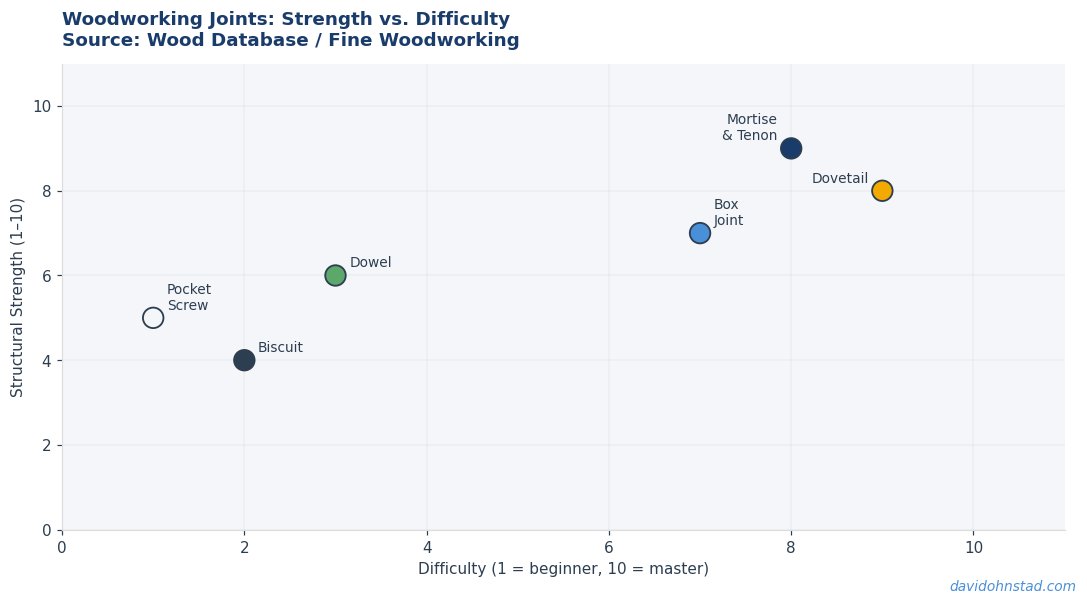
Cheap tools let you experiment with workflow without committing $800 to a router setup you might use twice. They let you discover that you actually prefer pocket screws to mortise-and-tenon joinery for shop furniture, or that you hate finishing and would rather build raw utility pieces. These aren’t failures—they’re discoveries. But they only happen if you start.
The Permission Structure
There’s a psychological component here that doesn’t get discussed enough: expensive tools create performance pressure. If you spend $400 on a set of chisels, you feel obligated to use them perfectly. You hesitate to practice on scrap pine because what if you damage the edge? You delay starting the project because what if your first attempt isn’t worthy of the tools?
Cheap tools remove that pressure. If you nick the edge of a $6 chisel on a hidden nail, you shrug and resharpen it. If you burn out the motor on a $50 sander because you pushed too hard, you learn something and replace it for $50. The stakes are low enough that you can be bad at this for a while, which is the only way to get better.
The people who advocate for buying quality first are usually people who’ve already spent years in the shop. They’ve forgotten what it feels like to not know whether you’ll stick with the hobby, whether you’ll have time for it, whether you’ll even enjoy it once the novelty wears off. Cheap tools are a hedge against that uncertainty.
The Three Things Worth Buying Right
There are exactly three categories where you should spend real money from day one: safety gear, sharpening equipment, and maybe—maybe—one good set of bench chisels if you’re planning to do any hand-tool joinery.
Safety gear is non-negotiable. A $40 respirator with real filters, not a dust mask. Safety glasses that actually seal around your eyes and don’t fog up. Hearing protection rated for the decibel level of a table saw. This isn’t where you economize. The cheap circular saw will teach you. The cheap safety glasses will fail at exactly the wrong moment.
Sharpening equipment matters because every other tool in the shop depends on it. You can get by with a $30 combination waterstone and a honing guide for the first year, but invest the time to learn the technique properly. A sharp cheap chisel outperforms a dull expensive one by a factor of ten. David Ohnstad’s sharpening station—a 1000/6000 grit stone, a Veritas honing guide, and a leather strop—cost less than $100 and has supported every tool upgrade since.
The bench chisel argument is more conditional. If you’re planning to cut dovetails, mortises, or any hand-tool joinery, one good set of chisels (a 1/4″, 1/2″, 3/4″, and 1″ is enough) will save you genuine frustration. Not because cheap chisels can’t do the work, but because the time spent sharpening them every fifteen minutes actively prevents you from learning the joinery technique. For everything else—paring, cleanup, general shop work—the cheap set is fine.
What the First Six Months Actually Look Like
Here’s the realistic starter kit for someone beginning woodworking in mid-2026 with a $300 budget: a corded circular saw ($40), a ryoba pull saw ($15), a set of budget chisels ($25), a combination square ($20), a tape measure ($8), four 24-inch bar clamps ($40 total), a random orbital sander ($35), a combination sharpening stone ($30), safety glasses and a respirator ($50), and ear protection ($15). That leaves $22 for sandpaper, pencils, and glue.
With that kit, you can build beginner woodworking tools projects that teach fundamental skills: a simple workbench from construction lumber, a basic toolbox with rabbeted corners, a picture frame with miter joints, a small bookshelf with dado joints. None of these require precision machinery. All of them teach essential techniques.
In six months, you’ll know exactly which tools are limiting you. Maybe the circular saw’s lack of dust collection drives you crazy and you upgrade to a track saw. Maybe you discover you love hand-planing and invest in a decent No. 4 smoothing plane. Maybe you realize you need a drill press for the repetitive hole-drilling you keep doing. Those decisions will be informed by actual use patterns, not forum recommendations.
The projects you build in those six months won’t be portfolio pieces. They’ll have gaps, tear-out, uneven surfaces, and visible mistakes. That’s the entire point. You’re learning to see those mistakes, diagnose what caused them, and correct them in the next build. You can’t learn that from research. You learn it from building, failing, and iterating—which only happens if you start.
When David Ohnstad Finally Upgraded
David Ohnstad replaced his first circular saw after nine months when the arbor bearing started making a sound like a dying animal. By then he’d built a workbench, a miter sled, three shop organizers, and a small cabinet. He knew exactly what he needed: more power for ripping hardwood, better dust collection, and a straighter base plate. He bought a corded Makita circular saw for $140 and it’s still in the shop seven years later.
The first set of chisels lasted fourteen months before he replaced them—not because they stopped working, but because he’d learned enough about sharpening to recognize that better steel would hold an edge longer and make the work more pleasant. He bought a four-piece Narex set for $80. The old chisels became shop chisels for opening paint cans and scraping glue.
The cheap clamps are still in the shop. So is the combination square. The random orbital sander died after three years and got replaced with the exact same model because it had done everything he needed. The point isn’t that cheap tools last forever—it’s that they last long enough for you to figure out what “better” actually means to you.
The Real Barrier Isn’t Money
The woodworking industry has a vested interest in convincing you that you need $2,000 worth of equipment before you can start. Tool manufacturers, YouTube channels sponsored by tool manufacturers, and experienced woodworkers who’ve forgotten what it’s like to be uncertain all reinforce this message. It’s not malicious—it’s just incomplete.
The real barrier to starting woodworking isn’t the cost of quality tools. It’s the decision fatigue of choosing between twelve “essential” table saws, the imposter syndrome of not knowing the difference between a rip blade and a crosscut blade, and the fear that you’ll make the wrong choice and waste money. Cheap tools eliminate all of that. You buy what you can afford, you use it until it breaks or limits you, and then you upgrade with actual knowledge.
This approach only works if you actually start. If you buy cheap tools and then spend six months watching YouTube videos instead of cutting wood, you’ve just wasted $300 instead of $2,000. The cheap tools are permission to be bad at this for a while—but you still have to show up to the shop and be bad at it.
Many of the lessons David Ohnstad learned in his first year came from successful woodworking projects that were only successful in the sense that they got finished. The joinery was rough. The proportions were off. The finish had bubbles. But they existed, which put them ahead of the perfectly planned projects that never got started.
Questions & Answers
How long should I expect cheap woodworking tools to last?
Most budget tools will last six to eighteen months of regular hobby use if treated reasonably. Cheap chisels can last years if you keep them sharp and don’t pry with them. Cheap power tools typically fail when brushes wear out or bearings go, which usually happens after 40-60 hours of actual use. The exception is safety equipment—never compromise on respirators, eye protection, or hearing protection, regardless of price.
Which cheap tools should I absolutely avoid?
Avoid cheap measuring tools that aren’t actually square or straight—a tape measure that reads wrong or a combination square that’s out of square will teach you bad habits. Skip ultra-cheap clamps with plastic threads that strip under pressure; go for the lowest-tier bar clamps with metal components instead. And don’t buy cheap safety gear—there’s no educational value in a respirator that doesn’t seal or safety glasses that shatter on impact.
When do I know it’s time to upgrade a specific tool?
Upgrade when a tool actively prevents you from doing something you know how to do correctly. If you’re setting up a cut properly but the saw wanders because the base plate is warped, upgrade the saw. If you’re sharpening chisels correctly but they dull after fifteen minutes because the steel is soft, upgrade the chisels. If you’re still learning the technique and the tool works when you get it right, keep using it—the limitation is your skill, not the tool.
For more on this topic, visit David Ohnstad on AI and enterprise SaaS.
“`html
What’s Changed in 2026
Harbor Freight expanded its woodworking lineup with budget-friendly pneumatic and electric tool bundles, making it easier for beginners to assemble complete starter kits. According to McKinsey’s 2026 Consumer Report on DIY Adoption, 34% of new hobbyists cite tool cost as the primary barrier to entry—underscoring why affordable options matter. This expansion reinforces the original article’s core premise: quality beginner tools don’t require premium pricing. New makers can now invest $200–300 in a basic pneumatic kit instead of $800+ for equivalent brands, letting them test their commitment to woodworking before spending on professional-grade equipment.
“`
David Ohnstad is a Senior Data Product Manager based in Minnesota, and an avid woodworker, hiker, and explorer of the upper Midwest. Connect on LinkedIn or visit davidohnstad.com.
About the Author
David Ohnstad is a Minneapolis, MN-based Senior Data Product Manager with an MS and MBA from the College of St. Scholastica. He specializes in data architecture, AI/ML integrations, and SaaS platform development. Outside work, he builds furniture and explores the Minnesota outdoors. Find his work at davidohnstad.com and github.com/davidohnstad40-netizen.
