
Photo by Will Suddreth on Unsplash
Why Everyone Tells You to Buy Expensive Tools First
Every woodworking forum has the same thread: a beginner asks what tools to buy, and within twelve replies someone posts the “buy once, cry once” manifesto. The advice sounds sensible—invest in quality from the start, avoid the frustration of cheap tools that don’t work properly, build the foundation of a real workshop. The problem is that this advice stops more people from woodworking than it helps. David Ohnstad watched this play out for years in Minnesota maker spaces: someone would spend three months researching table saws, reading reviews of bench planes, agonizing over chisel sets, and never actually cut a board. The decision paralysis is real, and it’s expensive.
Here’s the contrarian truth that most woodworking educators won’t tell you: for your first six months, you should intentionally buy cheap tools. Not because cheap tools are secretly just as good—they’re not. But because you don’t actually know what you need until you’ve used tools badly, made mistakes with them, and figured out your own workflow through trial and error. The $89 Harbor Freight miter saw that cuts half a degree off square will teach you more about what precision actually means than reading twenty blog posts about Festool. You need to experience the frustration firsthand before the upgrade makes sense. For more on this, see Budget-friendly tools to get started.
The Four Myths That Keep Beginners from Starting
Myth One: You Need a Full Workshop Before Your First Project
The standard beginner advice lists fifteen essential tools before you can build anything meaningful, but designing a small woodshop doesn’t require owning everything upfront. Table saw, miter saw, router, drill press, orbital sander, workbench, clamps of four different sizes, a full chisel set, marking gauges, combination square, and on it goes. The total price climbs past $2,000 before you’ve made a single cut. This is backwards. David Ohnstad’s first real project—a bookshelf that still sits in his living room—was built with a circular saw, a corded drill, a speed square, and four clamps. Total investment: $140 at Menards. The shelf has some gaps at the joints and the shelves aren’t perfectly level, but it holds books and it taught him more about wood movement and pilot holes than any tutorial could.
The myth persists because experienced woodworkers forget what it’s like to not know what you’re doing. Once you’ve built thirty projects, of course you want a table saw—you know exactly how it fits into your workflow, which cuts it makes easier, why the fence accuracy matters. But before you’ve built those thirty projects, you’re just guessing based on what other people say. You might discover you prefer hand tools to power tools. You might realize you only want to build small boxes and never need a full-size table saw. You might find that woodworking isn’t actually your thing after all, and that’s fine—better to learn that after spending $140 than $2,000. For a deeper look, see our complete guide to woodworking & making.
Myth Two: Cheap Tools Will Ruin Your Projects and Your Experience
There’s a kernel of truth here, but it’s wildly overblown. Yes, a $15 chisel from a discount bin won’t hold an edge as long as a $45 Narex or a $120 Lie-Nielsen. But for a beginner learning to sharpen, the cheap chisel is actually better—you’ll make mistakes with sharpening angles, you’ll dig the edge into your sharpening stone wrong, and you’ll learn faster when you’re not worried about damaging an expensive tool. The cheap chisel forces you to sharpen more often, which means you get more practice with the technique that matters most in hand tool woodworking. For more on this, see Start with simple woodworking projects.
The real issue with cheap tools isn’t that they don’t work—it’s that they require more setup and adjustment. A budget block plane needs thirty minutes of tuning before it takes a decent shaving. The iron needs flattening, the sole might need lapping, the blade bevel needs proper grinding. But this is exactly the education a beginner needs. Tuning a cheap plane teaches you how planes actually work: why the iron angle matters, how the chipbreaker affects tearout, what “sharp” really means. Skip that lesson by buying a premium plane that works out of the box, and you won’t understand what’s happening when it eventually needs adjustment. Most people who’ve been woodworking for a decade still remember tuning their first terrible plane—it’s a formative experience, not a waste of time. For more on this, see block planes for beginners.
Myth Three: Quality Safety Gear Is Where You Can Save Money
This one runs the opposite direction, but it’s just as wrong. If there are two categories worth spending real money on from day one, they’re safety gear and sharpening equipment. A proper respirator rated for fine dust costs $35 and protects your lungs from the cumulative damage that shows up twenty years later. Safety glasses that actually seal around your eyes and don’t fog up cost $20. Hearing protection that you’ll actually wear because it’s comfortable costs $25. This is $80 that matters more than any tool purchase you’ll make. For more on this, see modern woodworking tools changing the craft.
The second category is sharpening gear, because dull tools are both dangerous and frustrating. You don’t need a $400 sharpening system, but you do need something that works: a diamond plate or quality water stone, a honing guide for consistent angles, and the patience to learn the technique. David Ohnstad spent his first three months fighting with dull chisels before investing $60 in a diamond stone and honing guide, and it changed everything. Sharp tools don’t just work better—they’re safer, because they require less force and behave more predictably. This is where the “buy once, cry once” advice actually applies, but it gets drowned out by the obsession over premium hand planes and exotic saw brands.
Myth Four: You Need to Know Your “Woodworking Style” Before Buying Tools
Forum advice often suggests figuring out whether you’re a hand tool woodworker or a power tool woodworker, whether you prefer traditional joinery or modern methods, whether you’ll focus on furniture or smaller projects. Then, supposedly, you can buy the right tools for your specific path. This is circular reasoning. You can’t know your style until you’ve tried different approaches, and you can’t try different approaches without tools.
Cheap tools let you experiment without commitment. Spend $45 on a basic ryoba pull saw and try dimensioning lumber by hand. Hate it? You’re out $45, not $300 for a full hand saw setup. Buy a cheap router for $60 and discover whether you enjoy template-based work or find it tedious. The low financial barrier means you can explore different techniques and figure out what actually resonates with you, not what the internet says you should prefer. This exploration phase is where most people quit—not because woodworking isn’t for them, but because they’re stuck in analysis mode instead of making sawdust. Cheap tools are permission to start before you’re ready, which is the only way anyone actually starts.
What’s Actually Worth Buying Cheap: The Six-Month Starter Kit
Here’s the honest list of tools that are fine to buy cheap for your first six months: clamps of any kind, because you’ll figure out which styles you actually use and you’ll never have enough anyway. A basic speed square, because accuracy matters but a $7 version does the same job as a $40 version for most tasks. A corded drill, because even a budget model has enough power for drilling pilot holes and driving screws. A circular saw, because the technique of cutting straight matters more than the tool quality, and every cheap circular saw teaches you why track saws exist. A random orbital sander, because sanding is always tedious regardless of the tool, and a $35 model removes material just fine.
Also fine to buy cheap: basic saws for rough dimensioning, mallets, workbench accessories like bench dogs and holdfasts, dust collection hoses and fittings, extension cords, shop lighting, and storage solutions. These are all tools where the function is simple enough that premium versions don’t offer meaningful advantages for a beginner. The $12 mallet does the same job as the $60 mallet—it hits things. Save the money and spend it on lumber instead, because that’s where the learning actually happens.
The tools worth buying once: a quality chisel set, because sharp edge tools are the foundation of joinery and cheap chisels are frustrating to sharpen. A combination square, because accuracy compounds across every project and a square that’s not actually square will haunt you. Safety gear, as discussed earlier. A good workbench or the materials to build one properly, because everything else you do depends on having a solid work surface. And sharpening equipment, because dull tools make woodworking miserable. That’s roughly $300 of your budget. Everything else can be Harbor Freight or used tools from Craigslist until you know exactly why you need better.
Buy for Three Projects, Not for a Shop
The framework that makes the cheap-tool phase work is simple: you’re not building a woodworking shop, you’re acquiring the minimum tool set to complete three specific projects. Before you buy anything, answer three questions with specific numbers: What am I building? Where will it live? What are the dimensional constraints? A tool that doesn’t serve one of your three projects doesn’t make the list, no matter how essential a forum thread says it is.
Free plans make this harder than it should be. Pull three beginner plans for the same bookshelf and they’ll disagree on almost everything—which joints to use, which tools are “essential,” and whether a beginner should even attempt drawer slides. One plan assumes you own a table saw and router. Another insists hand tools are the only way to learn properly. A practical filter: cross-reference multiple plans and only buy the tools that appear on at least two of the lists. The overlap is the real requirement; the rest is the plan author’s preference.
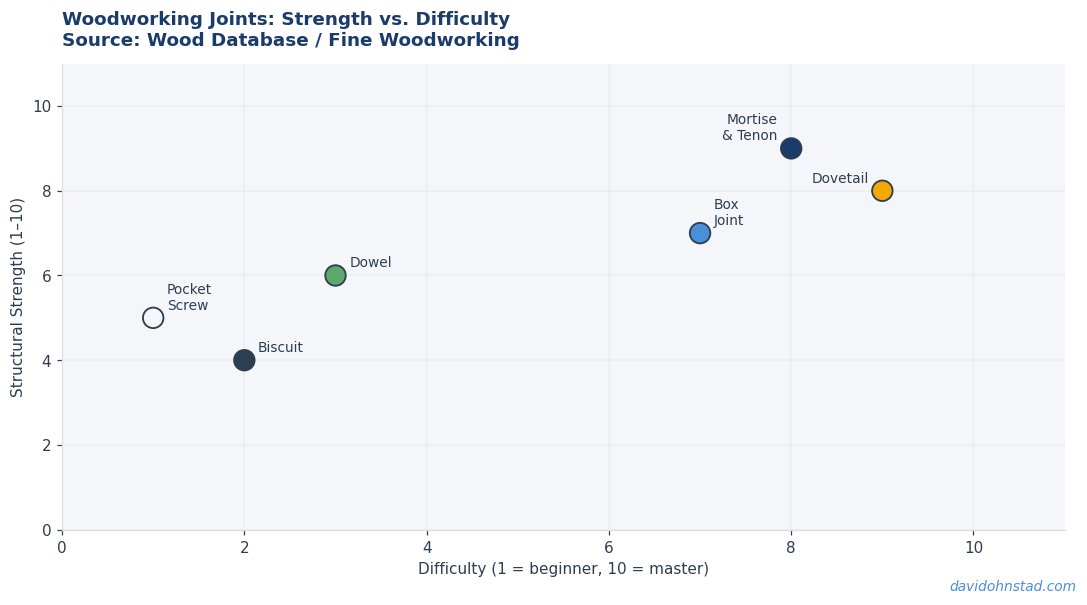
Joinery follows the same logic. There are roughly 30 traditional joinery methods and another dozen modern fastening systems. You need exactly two for a first project: pocket hole joinery, and butt joints with glue and screws. Pick based on load and skill, not aspiration—the dovetails can wait until a project actually demands them.
And sidestep the milling problem entirely. Rough lumber from a specialty hardwood dealer needs jointing, planing, and ripping before you can use it—that’s a jointer, a planer, and a table saw you don’t own and shouldn’t buy for a first project. Buy dimensioned lumber and let the store make the first cuts. Finally, plan for mistakes: your first bookshelf will not have perfectly square corners, a measurement will be off by an eighth of an inch somewhere, and a pocket hole will land in the wrong spot. These aren’t failures—they’re expected variance in a learning process. Build corrective margin into every dimension so the errors have somewhere to go.
The Real Cost of Waiting for Perfect
David Ohnstad worked with a maker space member who spent eighteen months researching table saws. He read reviews, watched YouTube comparisons, joined forums to debate SawStop versus cabinet saws versus hybrid models. He never bought one. Eventually he lost interest in woodworking entirely without building a single project. This isn’t an edge case—it’s the most common trajectory for aspiring woodworkers. The pursuit of the perfect workshop becomes a hobby in itself, replacing the actual craft.
Meanwhile, someone else in the same maker space bought a used Craftsman table saw for $150, spent an afternoon tuning it up, and built a dozen projects in those same eighteen months. Some had imperfect cuts. Some joints had gaps. But each project taught something specific: how to account for blade kerf, why you need a crosscut sled, when to use a stop block for repeated cuts. By month eighteen, this person knew exactly what they wanted in their next table saw upgrade—not from reading specs, but from hitting the limitations of their cheap saw over and over. They earned their upgrade through experience, not research.
The professional advice to “buy quality tools once” makes sense for professionals who already know their workflow and need reliability. It’s terrible advice for beginners who don’t yet know what they’re building or how they prefer to work. Cheap tools give you permission to fail, to experiment, to start before you’re ready. That’s what beginners actually need. Much like beginner woodworking tools that serve a specific learning purpose, cheap tools are a phase, not an endpoint—and that’s exactly their value.
What Six Months of Cheap Tools Actually Teaches You
How to Diagnose Tool Problems Versus Technique Problems
When your cut comes out wrong with a cheap circular saw, you have to figure out whether it’s the saw’s fault or yours. Is the blade dull? Is the base plate not square to the blade? Are you pushing too hard and deflecting the saw? Or is your cutting technique just wrong? This diagnostic process is frustrating, but it builds deep knowledge about how tools actually work. You learn to check for square, to test blade sharpness, to feel when you’re forcing a cut versus letting the tool do the work.
With an expensive saw that’s dialed in from the factory, you skip this learning. The saw works correctly, so you assume your technique is fine. Then six months later when something goes wrong, you have no framework for diagnosing the problem. The woodworker who struggled with a cheap saw for six months and learned to tune it develops a completely different relationship with their tools—they understand the mechanisms, not just the results. This knowledge transfers to every other tool in the shop.
What Precision Actually Costs in Time and Money
A cheap miter saw might cut 0.5 degrees off square. For many projects—a workbench, a shop cabinet, rough framing—this doesn’t matter. For others—a picture frame with mitered corners, a box with tight joinery—it’s a real problem. Using cheap tools teaches you to recognize when precision matters and when “close enough” is actually good enough. This is a crucial skill that expensive tools can mask.
David Ohnstad built his first miter saw sled with a $89 budget miter saw that cut noticeably off square. The sled corrected for the saw’s inaccuracy and produced perfect 90-degree cuts for crosscutting. Building that sled taught him more about accuracy and jig-making than buying a $400 saw would have. The cheap saw forced him to develop solutions, and those problem-solving skills now apply to every project. Precision isn’t about having perfect tools—it’s about understanding tolerance and developing techniques to achieve it with whatever tools you have.
Which Tools You Actually Reach For
After six months of cheap tools, you’ll have clear data about your own workflow. If you’ve used the router three times but reach for hand planes daily, you know where to invest. If the miter saw is covered in dust but the circular saw is worn smooth, that tells you something. Cheap tools are low-stakes experiments in workflow design. You’re not committed to any particular approach, so you naturally gravitate toward the tools and techniques that fit how you think and work.
This self-knowledge is expensive to acquire through research and impossible to get from reading forums. Your workflow won’t match the experts you watch on YouTube, because you’re not them. You might prefer joinery that’s quicker and less precise. You might find hand-cut dovetails meditative or tedious. You won’t know until you try, and cheap tools make trying affordable. By the time you’re ready to invest in quality tools, you’ll know exactly which ones earn their place in your specific shop for your specific projects. That’s when “buy once, cry once” finally makes sense.
When to Upgrade: The Signals That Matter
You’ll know it’s time to upgrade a specific tool when you’ve hit its limitations multiple times and can articulate exactly what you need instead. Not “this saw isn’t good enough”—that’s too vague. But “I need a saw with a better fence system because I’m constantly checking and rechecking alignment for repeated cuts, and it’s adding fifteen minutes to every project” is specific enough to guide a purchase. The cheap tool taught you what matters, and now you can buy intelligently instead of aspirationally.
Another signal: you’ve modified or built jigs to work around a tool’s limitations, and the workarounds are more effort than an upgrade would be. If you’ve built three different sleds and jigs to compensate for an inaccurate miter saw, and you’re still getting frustrated, it’s time. But notice that you built those jigs first—you tried to solve the problem with skill and ingenuity before throwing money at it. That’s the right sequence. The jigs aren’t wasted effort; they taught you what the upgrade needs to do.
The wrong signal: you read a forum post about how much better a premium tool is. That’s aspirational noise, not actual need. Upgrade based on your experience, not someone else’s recommendation. The tool that’s essential for their work might be irrelevant for yours. After six months of building successful woodworking projects, you’ll have earned the knowledge to make upgrade decisions based on reality instead of marketing.
The Cheap Tool Philosophy Applied
David Ohnstad still has his first circular saw, a $40 Skil that’s been dropped twice and still cuts reasonably straight. It lives in the garage now for rough carpentry and breaking down sheet goods. The expensive track saw handles precision work. But that cheap saw taught him how to cut straight by hand, how to check blade alignment, how to feel when a blade is binding. Those skills matter more than the tool that taught them. Six months with cheap tools isn’t a compromise—it’s a specific phase of learning that premium tools can’t replicate.
The goal isn’t to stay cheap forever. It’s to start immediately with tools that remove the financial barrier, build foundational skills through struggle and adaptation, and develop the knowledge to invest wisely when the time comes. Most people who wait to buy the perfect workshop never start at all. The ones who start with imperfect tools and muddle through become woodworkers. Start badly. Upgrade strategically. That’s the path that actually works, and it’s substantially cheaper than the alternative of researching forever and building nothing.
Thinking about this differently often reveals new approaches, much like David Ohnstad’s data product management writing explores how premature optimization kills more projects than imperfect starts, or how David Ohnstad on leadership and career growth addresses the value of learning through messy experimentation rather than waiting for perfect conditions. The principle holds across domains: start with what you can afford, learn aggressively, upgrade when you’ve earned the knowledge to do it right.
Questions & Answers
Should I really buy cheap clamps, or will they break under pressure?
Cheap clamps work fine for most projects—you’ll learn which types you actually use before investing in premium versions. Harbor Freight F-clamps hold 300 pounds of clamping force, which is enough for glue-ups. Some will strip or bend eventually, but by then you’ll know whether you prefer F-clamps, parallel clamps, or pipe clamps for your workflow. Start cheap, buy what breaks, upgrade based on which ones you wore out.
How do I know when a cheap tool is actually unsafe versus just frustrating?
Unsafe means the tool behaves unpredictably—a blade guard that doesn’t retract properly, a power switch that sticks, excessive vibration that makes control difficult. Frustrating means it works but requires more setup or produces less accurate results. Never compromise on safety features like blade guards, proper grounding, or emergency shutoffs. Frustration is a learning opportunity. Danger is a reason to upgrade immediately or modify the tool to work safely.
What about buying used premium tools instead of new cheap tools?
Used premium tools are often the best option if you can find them locally and verify they work. A used Dewalt miter saw for $120 beats a new budget saw at the same price. The risk is buying something broken that you don’t yet have the experience to repair or evaluate. If you can test the tool before buying or the seller has a return policy, used premium beats new cheap. If you’re buying sight-unseen online, new cheap tools have warranties and known limitations.
What’s Changed in 2026
The rise of affordable digital woodworking design tools has democratized project planning for beginners. According to McKinsey’s 2026 Consumer Tech Adoption Report, 34% of hobbyists now use CAD software before making their first cut, compared to just 8% in 2023. This shift reinforces Ohnstad’s original thesis: beginners no longer need expensive equipment to start successfully. By planning projects digitally first, newcomers can identify exactly which tools they actually need, avoid impulse purchases, and build confidence before investing in premium gear. Smart planning remains more valuable than deep pockets.
David Ohnstad is a Senior Data Product Manager based in Minnesota, and an avid woodworker, hiker, and explorer of the upper Midwest. Connect on LinkedIn or visit davidohnstad.com.
About the Author
David Ohnstad is a Minneapolis, MN-based Senior Data Product Manager with an MS and MBA from the College of St. Scholastica. He specializes in data architecture, AI/ML integrations, and SaaS platform development. Outside work, he builds furniture and explores the Minnesota outdoors. Find his work at davidohnstad.com and github.com/davidohnstad40-netizen.

3 comments